
Summary
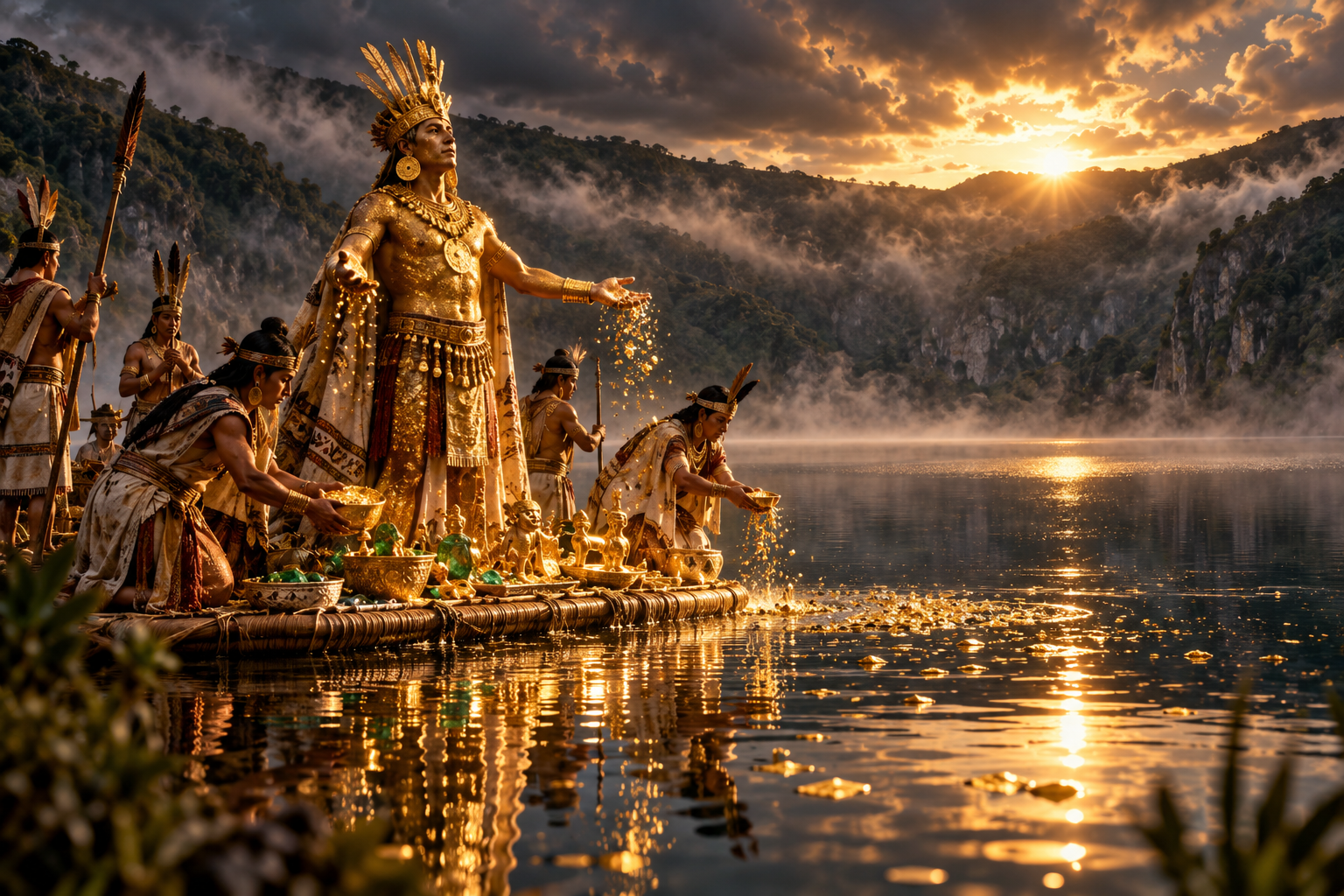
El Dorado is the legendary city of gold that European explorers sought across South America for centuries. Its origins, however, lie in accounts of a gilded ruler among the Muisca people of present-day Colombia. According to the tradition, a newly appointed chief was covered in gold dust and participated in a ceremony at Lake Guatavita, where precious offerings were placed in the water. As stories spread, the gilded man became a supposedly wealthy city and eventually an entire kingdom. Although the Muisca culture and its gold offerings are historically documented, the legendary golden city has never been found.
Additional Notes
The legend of El Dorado developed from accounts of the Muisca, an Indigenous civilization that inhabited the highlands of present-day Colombia. Early Spanish reports described a ruler known as “El Dorado,” meaning “the gilded one.” According to later descriptions of the ceremony, a newly appointed chief was covered in gold dust and travelled on a ceremonial raft across Lake Guatavita, accompanied by attendants and priests. Gold objects and emeralds were offered to the sacred waters as part of the ritual. The connection between the legend and Muisca ceremonial practices is supported by archaeological discoveries, particularly the famous Muisca Raft, a small gold-alloy votive sculpture depicting a ruler and accompanying figures on a boat. The object was discovered near Pasca, Colombia, in 1969 and is preserved in the Gold Museum in Bogotá. It provides valuable evidence of Muisca ritual imagery, although it does not establish that every detail of the later written accounts occurred exactly as described. During the sixteenth century, stories of the gilded ruler spread among European explorers and gradually changed. El Dorado became the name of an immensely wealthy city, and later of an entire kingdom supposedly hidden somewhere in South America. Spanish expeditions and later English searches pursued these rumours through mountains, forests and river systems. Some versions placed the golden city of Manoa beside a vast lake called Parime in the Guiana region. Lake Guatavita itself attracted repeated treasure-hunting attempts. Expeditions tried to lower or drain its waters in the hope of recovering enormous quantities of gold. Although gold offerings associated with Muisca religious practices are historically documented, no discovery confirmed the existence of the fabulous treasure imagined by European treasure hunters. Today, El Dorado remains a striking example of how a real cultural tradition can develop into a far-reaching legend. The lake, the Muisca goldwork and the historical searches are tangible parts of its story, while the supposed lost city and its extraordinary riches remain unverified.
The Location Today
Laguna de Guatavita is associated with the original legend of El Dorado, in which a gilded Muisca ruler is said to have performed a ceremony involving gold and precious offerings cast into the lake. It is not believed to be the site of a sunken golden city; that idea developed from later versions of the legend. Laguna de Guatavita is a real mountain lake within a protected forest reserve in the municipality of Sesquilé, Cundinamarca, Colombia. It is closely associated with the original El Dorado legend and the ceremonial traditions of the Muisca people. The lake can be visited through regulated guided tours, with viewpoints overlooking the water. The map marker identifies this historically associated location, not the site of a verified lost golden city. The reserve is administered by the Corporación Autónoma Regional de Cundinamarca (CAR).
- Environment
- Lake, Mountain, Highland
- Time of Day
- Unknown time of day
- Evidence Level
- Folklore
- Visiting the Location
- Free Access, Guided
- Ownership of the Location
- Public