
Summary
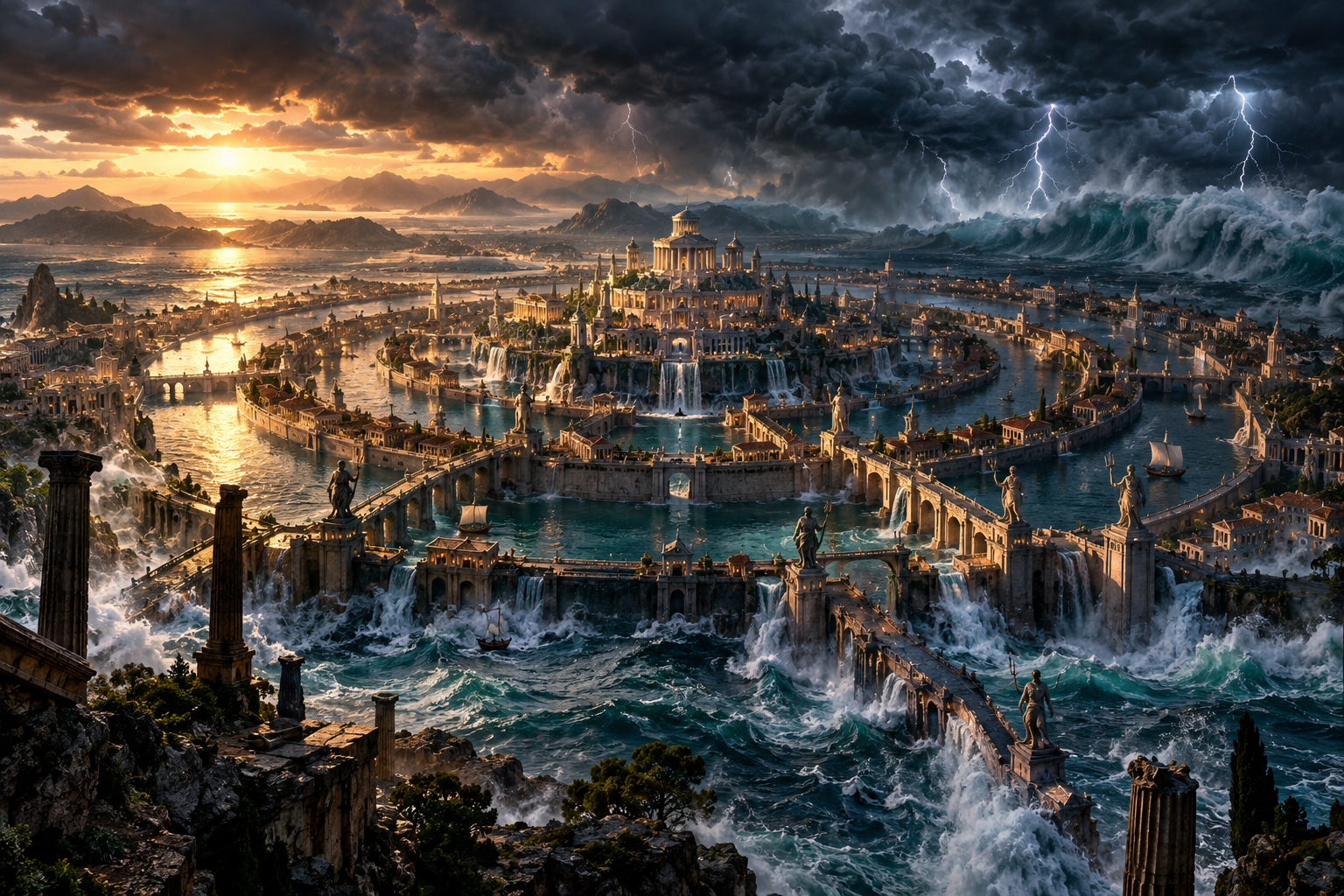
Atlantis is the legendary island civilization described by the Greek philosopher Plato in his dialogues Timaeus and Critias, written around 360 BCE. According to the story, a powerful maritime kingdom existed beyond the Pillars of Heracles, generally identified with the Strait of Gibraltar. Its rulers eventually challenged ancient Athens before catastrophic earthquakes and floods caused Atlantis to disappear beneath the sea. Despite centuries of speculation and proposed locations, no archaeological evidence has established that Plato's Atlantis existed as a historical civilization. Its origins and enduring fascination remain subjects of historical and philosophical debate.
Additional Notes
The earliest surviving account of Atlantis appears in Plato's dialogues *Timaeus* and *Critias*, composed during the fourth century BCE. In the narrative, the story is traced through the Athenian statesman Solon, who supposedly learned of the ancient civilization from Egyptian priests. They described a powerful island kingdom located beyond the Pillars of Heracles, with its great war against Athens taking place approximately 9,000 years before Solon's time. In *Critias*, Plato describes an extraordinary capital surrounded by alternating concentric rings of land and water. The sea god Poseidon was said to have created these rings and established a royal dynasty through his ten sons. The island possessed fertile plains, impressive buildings, temples, harbours and extensive maritime power. Its rulers initially prospered, but over generations their divine heritage supposedly weakened and their ambitions became increasingly destructive. According to *Timaeus*, Atlantis attempted to extend its power across the Mediterranean but was defeated by ancient Athens. Subsequently, violent earthquakes and floods struck, and the island disappeared beneath the sea within a single day and night. Plato's account also describes the surrounding waters becoming difficult to navigate because of the mud left behind by the sinking landmass. Atlantis is generally interpreted by scholars as a philosophical narrative exploring political power, moral decline and the qualities of an ideal society. Nevertheless, the possibility of a historical inspiration has encouraged numerous theories, including comparisons with the Minoan civilization and the volcanic destruction associated with Santorini. Other proposed locations range from the Atlantic Ocean to various parts of the Mediterranean. None of these proposals has established the existence of the civilization described by Plato. No independently verified archaeological discovery has identified Atlantis, and the surviving ancient account does not provide a precise location. Whether the story was entirely Plato's invention or incorporated elements of older traditions remains debated. Its enduring mystery lies in the extraordinary detail of the narrative and the persistent search for a civilization that may never have existed.
The Location Today
The map marker is symbolic and is placed in the Atlantic Ocean west of the Strait of Gibraltar, reflecting Plato's description of Atlantis as lying beyond the Pillars of Heracles. No archaeological evidence has established the existence or actual location of Atlantis.
- Environment
- Ocean / Sea, Island
- Time of Day
- Unkown time of day
- Evidence Level
- Folklore
- Visiting the Location
- Not Applicable
- Ownership of the Location
- Not Applicable