
Summary
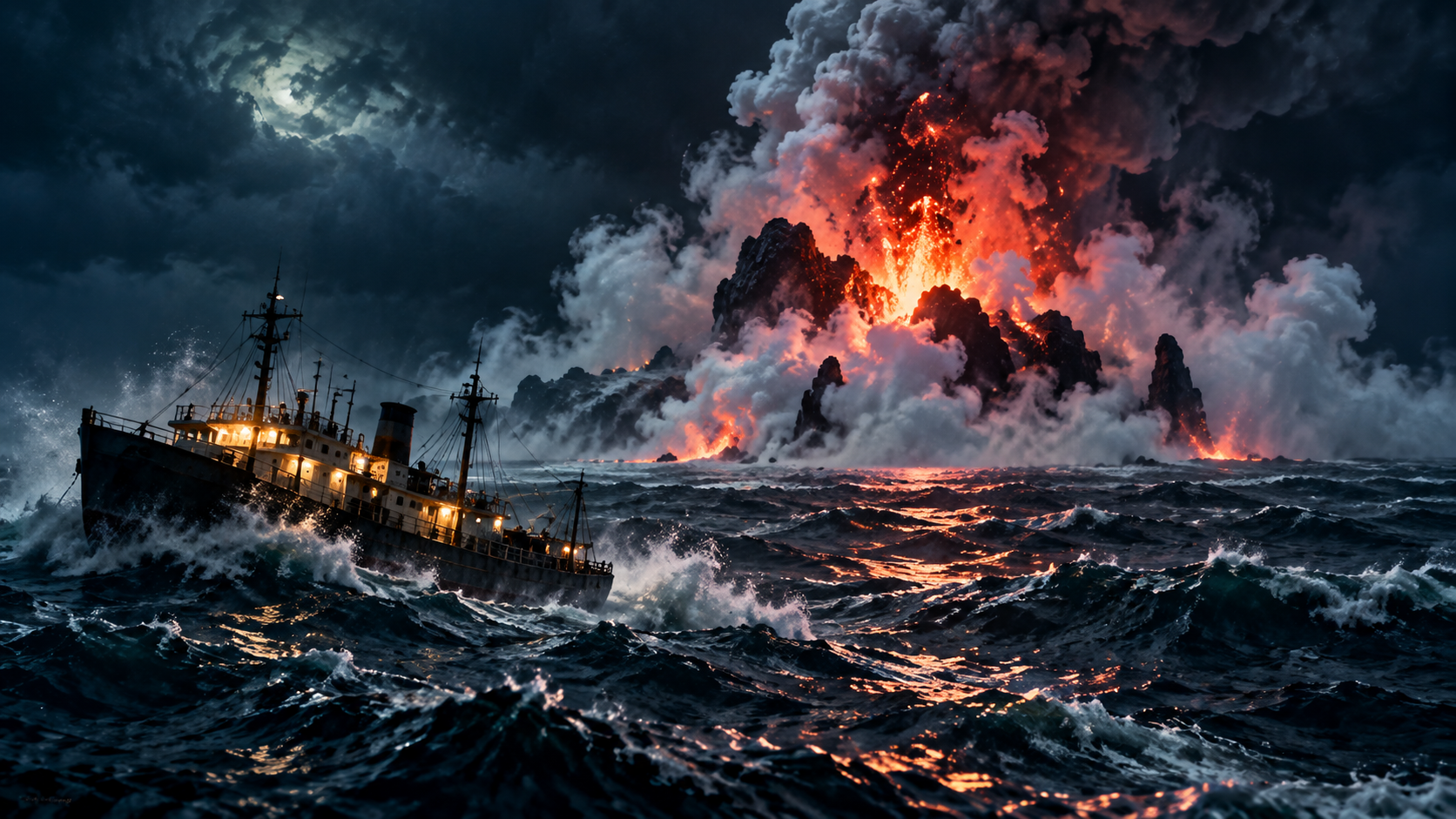
The Devil's Sea, also known as the Dragon's Triangle, is a loosely defined region of the Pacific Ocean south of Japan that has been compared with the Bermuda Triangle. Stories describe ships and aircraft disappearing under mysterious circumstances, particularly during the 1950s. However, later examination of the legend found that several widely repeated claims were exaggerated or misleading. Its most famous loss, the Japanese survey vessel Kaiyō Maru No. 5, was destroyed in 1952 while investigating the active submarine volcano Myōjin-shō. Although individual maritime losses may remain unresolved, there is no established evidence of a single anomalous phenomenon operating within a defined “Devil's Sea.”
Additional Notes
The Devil's Sea is commonly described as a dangerous or mysterious region of the Pacific south of Tokyo, but its supposed boundaries vary considerably between accounts. The Japanese expression ma no umi (“devil sea” or “dangerous sea”) was not historically restricted to one fixed paranormal triangle. During the 1950s, Japanese reporting associated the expression with a region south of Japan after several maritime incidents, and the idea was later transformed into a counterpart of the Bermuda Triangle in Western mystery literature. The best-known incident associated with the legend occurred on 24 September 1952. The Japanese hydrographic survey vessel Kaiyō Maru No. 5, carrying 22 crew members and nine scientific specialists, disappeared while investigating Myōjin-shō, an actively erupting submarine volcano approximately 450 kilometers south of Tokyo. The eruption had begun days earlier and had repeatedly created and destroyed a temporary volcanic island. Contemporary scientific studies recorded powerful explosions, tsunamis and other evidence of intense volcanic activity. The fate of Kaiyō Maru No. 5 was subsequently reconstructed from independent instrumental evidence. Tsunami observations in Japan and long-range SOFAR hydroacoustic recordings detected a major volcanic explosion at approximately 12:20 JST on 24 September. Researchers concluded independently from these records that the vessel had been destroyed by the eruption. All 31 people aboard were lost. The incident therefore represents a documented volcanic disaster rather than an unexplained disappearance. Later popular accounts substantially expanded the Devil's Sea story. Claims circulated that several Japanese military vessels had vanished, that hundreds of crew members had disappeared and that the Japanese government had dispatched Kaiyō Maru No. 5 specifically to investigate mysterious losses. Later critical research challenged these claims, identifying several vessels as fishing boats rather than military ships and noting that some losses occurred outside the boundaries later assigned to the “triangle.” Kaiyō Maru No. 5 had in fact been sent to investigate volcanic activity. The Devil's Sea therefore differs from a single unresolved incident. Individual ship losses in the waters south of Japan cannot all be assigned a known cause, but the available historical and scientific evidence does not establish a geographically defined zone in which vessels disappear through a common unexplained mechanism. The modern Dragon's Triangle is best understood as a maritime legend built around real hazards and genuine disasters, particularly the highly active volcanic region surrounding Myōjin-shō.
The Location Today
The Devil's Sea does not refer to a single fixed or officially defined location. The waters south of Japan remain an active maritime and volcanic region, including the submarine volcanic area around Myōjin-shō.
- Environment
- Ocean / Sea
- Time of Day
- Various times of day
- Evidence Level
- Folklore
- Visiting the Location
- Not Applicable
- Ownership of the Location
- Not Applicable