
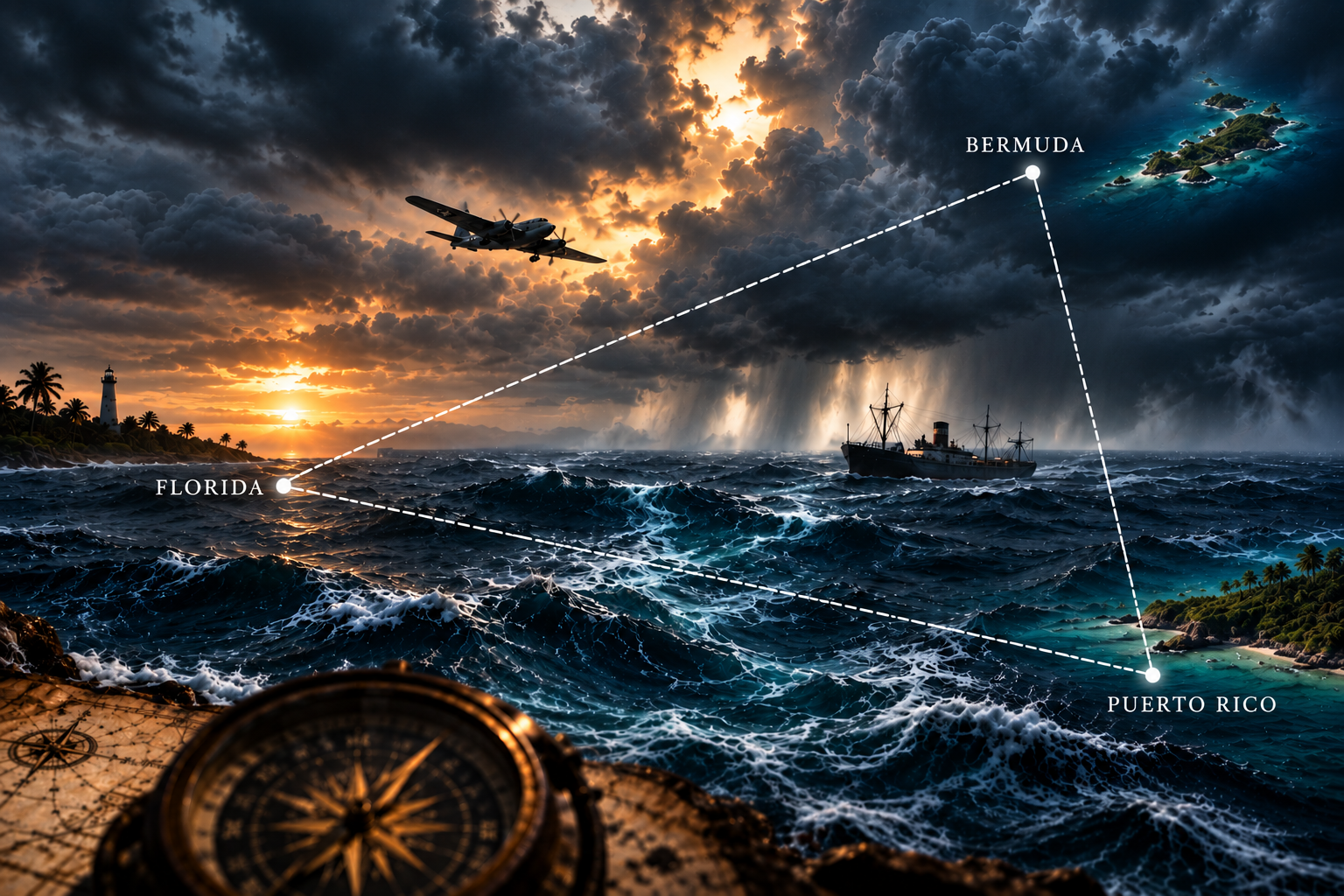
Summary
The Bermuda Triangle is a loosely defined region of the western North Atlantic associated with stories of ships and aircraft disappearing under mysterious circumstances. The modern legend took shape during the mid-20th century and gained its familiar name after writer Vincent Gaddis used the term “Bermuda Triangle” in 1964. Several incidents associated with the region, including Flight 19 and the USS Cyclops, remain unresolved, but no evidence has established an unusual rate of disappearances or a common unexplained phenomenon connecting them.
Additional Notes
Stories of unusual disappearances in the western North Atlantic circulated before the Bermuda Triangle received its familiar name. In 1950, journalist E. V. W. Jones discussed unexplained losses in the region, and a 1952 article by George X. Sand in Fate magazine described several incidents within a roughly triangular area. In 1964, writer Vincent H. Gaddis used the expression “Bermuda Triangle” in his article “The Deadly Bermuda Triangle,” helping establish the concept in popular culture. Some of the incidents later associated with the Triangle are genuine unresolved losses. The USS Cyclops disappeared in 1918 with more than 300 people aboard and was never recovered. On December 5, 1945, five U.S. Navy TBM Avenger aircraft known collectively as Flight 19 disappeared during a training mission after experiencing navigational difficulties. Neither the aircraft nor their 14 crew members were conclusively recovered. A PBM Mariner sent to search for Flight 19 also disappeared, although evidence strongly suggests that aircraft suffered a fire or explosion rather than an unexplained disappearance. The legend expanded dramatically through books, magazine articles and later television documentaries. Charles Berlitz's bestselling 1974 book The Bermuda Triangle helped popularize suggestions involving unusual magnetic effects, unexplained forces and other extraordinary causes. However, incidents attributed to the Triangle occurred across different periods and circumstances, and the boundaries of the supposed region have never been formally established. Some widely repeated accounts also became more mysterious through later retelling than the surviving historical evidence supports. Natural conditions in the region include rapidly changing tropical weather, hurricanes, shallow reefs, extensive deep-water areas and the powerful Gulf Stream, which can quickly disperse wreckage and debris. Navigation and human error have also provided plausible explanations for a number of individual incidents. NOAA states that there is no evidence that mysterious disappearances occur in the Bermuda Triangle with greater frequency than in other large, heavily travelled areas of the ocean. The Bermuda Triangle therefore remains primarily a modern maritime legend built around a mixture of genuine unresolved disappearances, explainable accidents and decades of popular storytelling. Cases such as Flight 19 and the USS Cyclops retain unanswered questions of their own, but no evidence has demonstrated that they were caused by a single anomalous phenomenon associated with the region. As the Bermuda Triangle represents a collection of incidents reported over many decades rather than a single event, the witness count is a conservative estimate and does not represent a verified total of independent witnesses.
The Location Today
The Bermuda Triangle is a loosely defined area of the western North Atlantic, generally described in relation to Bermuda, Florida and Puerto Rico. It has no official fixed boundary or single visitor location; access depends on individual destinations within the region.
- Environment
- Ocean / Sea, Airspace, Ship
- Time of Day
- Various times of the day
- Evidence Level
- Newspaper Report
- Visiting the Location
- Not Applicable
- Ownership of the Location
- Not Applicable