
Summary
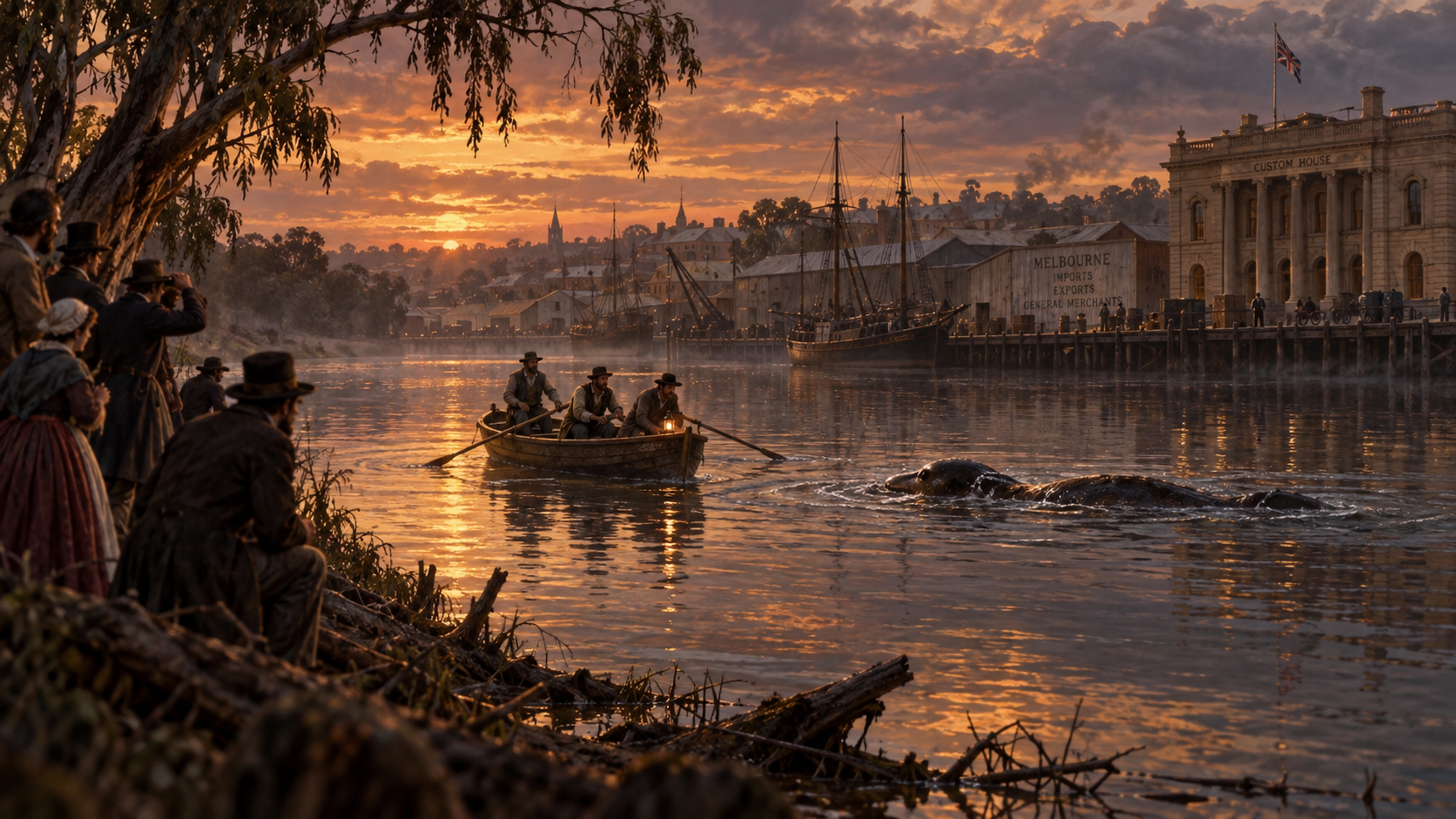
In March 1847, an unusual aquatic animal was reported in the Yarra River in central Melbourne, directly opposite the colonial Custom House. Contemporary newspaper coverage referred to the animal as a “Bunyip” or an exceptionally large platypus. A crowd gathered on the riverbank, and three men set out in a boat to investigate. When they approached to within roughly a yard of the animal, it disappeared beneath the water. The brief encounter became one of the earliest recorded Bunyip reports associated directly with Melbourne and the Yarra River.
Additional Notes
The Yarra River, traditionally known as Birrarung, has held deep cultural importance for the Wurundjeri Woi-wurrung people for countless generations. The river provided food, water, meeting places and sites of spiritual significance, while wetlands, billabongs and deeper pools formed part of a much larger cultural landscape. Modern Victorian sources continue to recognize Birrarung as a living cultural entity rather than simply an urban waterway. The 1847 report occurred during a period when European settlers were intensely interested in the possibility that Australia still contained large animals unknown to science. Bunyip stories had already entered colonial newspapers, and the supposed Bunyip skull from Balranald had attracted considerable attention only shortly before. As a result, unfamiliar animals seen in rivers and wetlands were sometimes quickly interpreted through the emerging settler idea of the Bunyip as a mysterious zoological creature. According to a report published in The South Australian on 2 March 1847, an animal described as either a Bunyip or an enormous platypus was seen resting on the surface of the Yarra opposite Melbourne’s Custom House. The sight immediately attracted spectators. Three men launched a boat and approached the animal, but it submerged when they came very close and was not captured. No physical evidence was recovered. The location makes this case particularly unusual. In the 1840s the lower Yarra was already becoming the centre of rapidly expanding Melbourne, although the river still retained far more natural banks, wetlands and wildlife habitat than it does today. European settlement along the Yarra had begun only in 1835, and much of the river corridor was still undergoing dramatic transformation. The animal itself was never identified. A large platypus was suggested even in the original account, while later explanations proposed for Bunyip reports elsewhere in Victoria have included seals, swimming mammals, large waterbirds and misidentified known wildlife. Nineteenth-century ethnographer Robert Brough Smyth recorded that Bunyip descriptions varied considerably and that the creature was especially associated with deep rivers, lagoons, swamps and waterholes. The Yarra case is therefore useful because it shows how Indigenous water-being traditions and colonial natural-history speculation became intertwined. The 1847 sighting does not establish the existence of an unknown animal, but it demonstrates how quickly the term “Bunyip” had entered European Melbourne culture and how seriously some early settlers considered the possibility of an unidentified aquatic species.
The Location Today
The Yarra River, also known as Birrarung, still passes through Melbourne and its surrounding parklands. Public trails and riverfront areas offer opportunities to explore the landscape, but the precise location of the reported nineteenth-century bunyip sighting has not been independently established.
- Environment
- River, Urban Area
- Time of Day
- Unknown / Daytime likely
- Evidence Level
- Witness Report
- Visiting the Location
- Free Access, Limited
- Ownership of the Location
- Mixed