
Summary
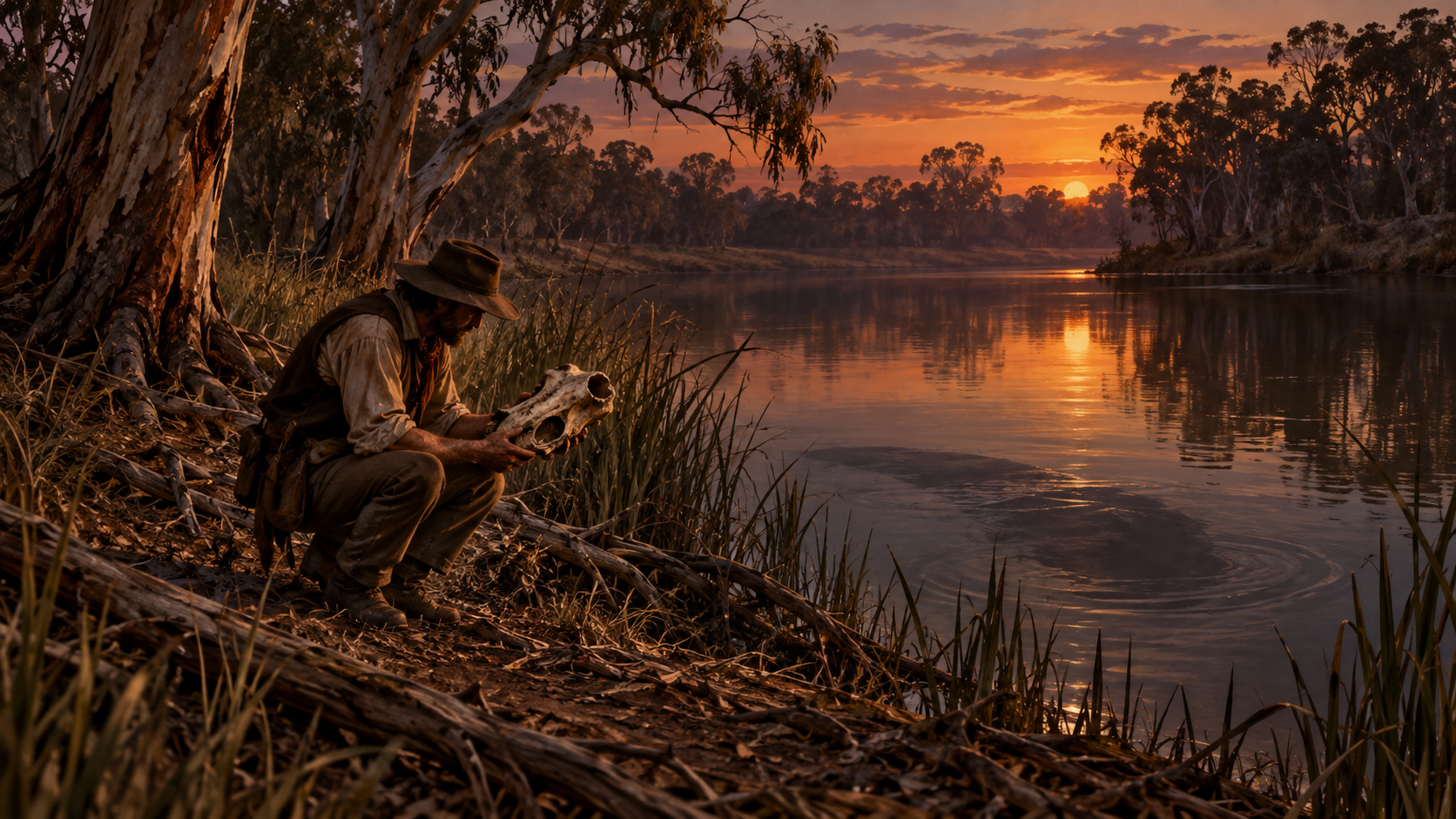
In the mid-1840s, an unusual skull was found along the Murrumbidgee River near Balranald in New South Wales and was widely associated with the Bunyip, a feared water-being from Aboriginal traditions of southeastern Australia. Local Aboriginal people reportedly identified the skull as belonging to a Bunyip, while European naturalists initially debated whether it represented an unknown Australian animal. The specimen was later displayed publicly in Sydney, attracting considerable attention, before specialists concluded that it was most likely a malformed skull from a known mammal rather than evidence of an unknown species.
Additional Notes
The Balranald case is one of the best-known nineteenth-century episodes in the history of the Bunyip because it briefly appeared to provide physical evidence for a creature that had previously been known primarily through Aboriginal tradition and settler stories. The skull was reportedly discovered on the banks of the Murrumbidgee River near Balranald around 1845 or early 1846. Accounts differ slightly on the exact year, but the find quickly attracted attention because its shape did not seem to match familiar Australian animals. According to later historical accounts, Aboriginal people who saw the skull identified it as belonging to a Bunyip. For local Mutthi Mutthi and Wemba people, the Bunyip was not simply a curiosity but part of a wider cultural understanding of dangerous deep-water places. Elder Uncle Daniel Kelly later recalled being warned as a child not to swim alone in deep or fast-flowing sections of the Murrumbidgee because the Bunyip might take him. He described the being as culturally significant and connected with creation and the river landscape. The skull was examined by several nineteenth-century naturalists. Some initially suggested that it might represent an unknown Australian species, while others were more skeptical. In 1847 it was deposited at the Australian Museum and briefly displayed to the public as the “cranium of the supposed Bun-Yip.” The exhibition generated considerable public interest and reportedly encouraged people to recount further alleged Bunyip encounters. Scientific opinion soon moved away from the idea of a new animal. Naturalists including William Sharp Macleay argued that the skull was more likely a malformed specimen from a known mammal, and later interpretations have generally agreed that it did not represent an unknown species. The episode nevertheless became historically important because it transformed the Bunyip, for a short time, from an oral and folkloric figure into a supposed zoological mystery. The Murrumbidgee itself remained strongly associated with Bunyip traditions. Elsewhere along the river, places known locally as “Bunyip Holes” preserve similar stories of dangerous deep water and mysterious creatures. Modern NSW heritage and tourism material still records Bunyip traditions along the Murrumbidgee, showing how persistent the association between the river and the creature has remained. Today the Balranald skull episode is best understood as a meeting point between Aboriginal tradition, nineteenth-century natural history and colonial fascination with unknown Australian animals. The skull itself is not accepted as evidence for an unidentified creature, but the Bunyip tradition associated with the Murrumbidgee remains culturally and historically significant.
The Location Today
Balranald is still a town beside the Murrumbidgee River in New South Wales. Its visitor centre and local museum can be visited, but no present-day public display of the alleged nineteenth-century bunyip skull has been verified in this review.
- Environment
- River, Swamp / Marsh
- Time of Day
- Unknown time of the day
- Evidence Level
- Folklore
- Visiting the Location
- Unknown
- Ownership of the Location
- Unknown