
Summary
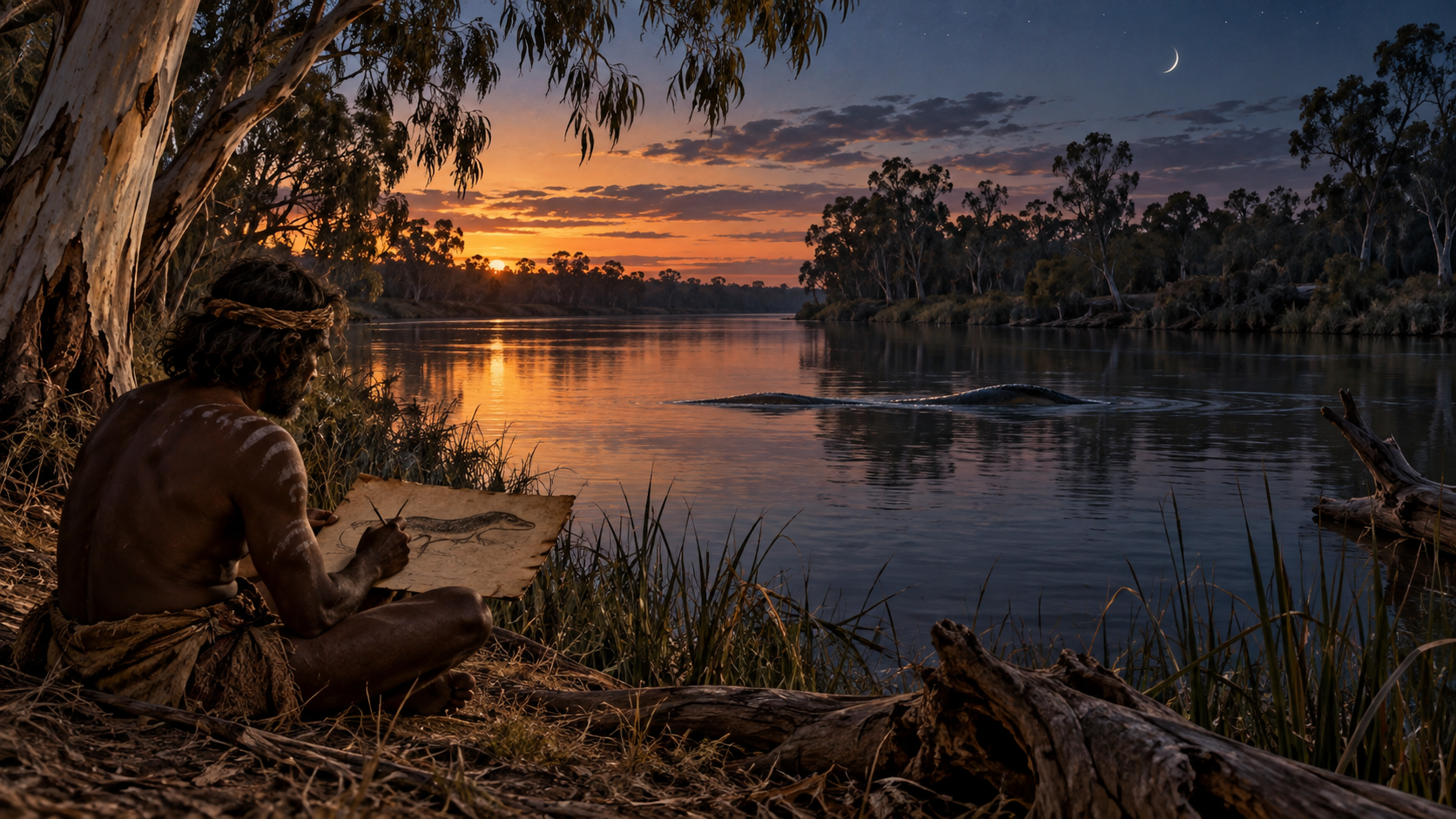
The Murray River and its surrounding wetlands form one of the most important historical regions associated with Bunyip traditions in southeastern Australia. Aboriginal accounts described dangerous beings inhabiting deep waterholes, lagoons and river channels, while nineteenth-century European settlers recorded these stories and sometimes claimed sightings of unusual aquatic animals themselves. In 1848, an Aboriginal man from the Murray River produced one of the earliest known drawings of a Bunyip, illustrating how strongly the creature was associated with the river landscape.
Additional Notes
Bunyip traditions were widespread among Aboriginal communities of southeastern Australia and were particularly associated with deep, still or dangerous water. Nineteenth-century ethnographer Robert Brough Smyth recorded that people camping near lagoons, deep waterholes or riverbanks sometimes spoke of frightening calls, groans or bellows coming from the water. The creature was generally described as powerful and dangerous, but its physical appearance varied greatly between regions. The Murray River is especially significant because one of the earliest surviving visual representations of the creature came from the region. In 1848, an Aboriginal man from the Murray River drew a Bunyip in the presence of European observers. The image was later reproduced by Brough Smyth and shows a long-bodied creature with a small head and multiple legs or appendages. Its exact features are ambiguous, reflecting the wider problem that Bunyip descriptions differed considerably between communities and witnesses. The Murray River and its tributaries also became part of nineteenth-century settler reports. In 1857, artist and explorer Edwin Stocqueler travelled along the Murray and Goulburn rivers and reported seeing several unusual aquatic animals. Newspaper accounts described the creatures in dramatic terms and identified them as Bunyips, although Stocqueler later objected to parts of the published descriptions and stated that he himself had not confidently called the animal a Bunyip. This distinction is important. Aboriginal Bunyip traditions cannot simply be reduced to European cryptozoological sightings. Within Indigenous cultural frameworks, dangerous water beings often served as part of a broader understanding of particular places, risks and relationships with the landscape. In later settler culture, however, the Bunyip increasingly became treated as a mysterious animal that might one day be scientifically identified. The Murray River tradition therefore sits at the intersection of Indigenous cultural knowledge and nineteenth-century colonial fascination with unknown Australian fauna. Some reported sightings may have involved seals, large fish, swimming mammals or other known animals, but no biological evidence has established the existence of an unknown species corresponding to the Bunyip. 1848 is used here as the sort year because the Murray River drawing provides a clear historical anchor for the regional tradition. The Bunyip stories themselves are older and cannot be assigned a reliable beginning date.
The Location Today
The Murray River continues to flow through towns, farmland, reserves and culturally significant landscapes across south-eastern Australia. The bunyip traditions concern a broad river region rather than a single identified monument or preserved encounter site.
- Environment
- River, Swamp / Marsh
- Time of Day
- Various, often night
- Evidence Level
- Folklore
- Visiting the Location
- Free Access, Limited
- Ownership of the Location
- Mixed