
Summary
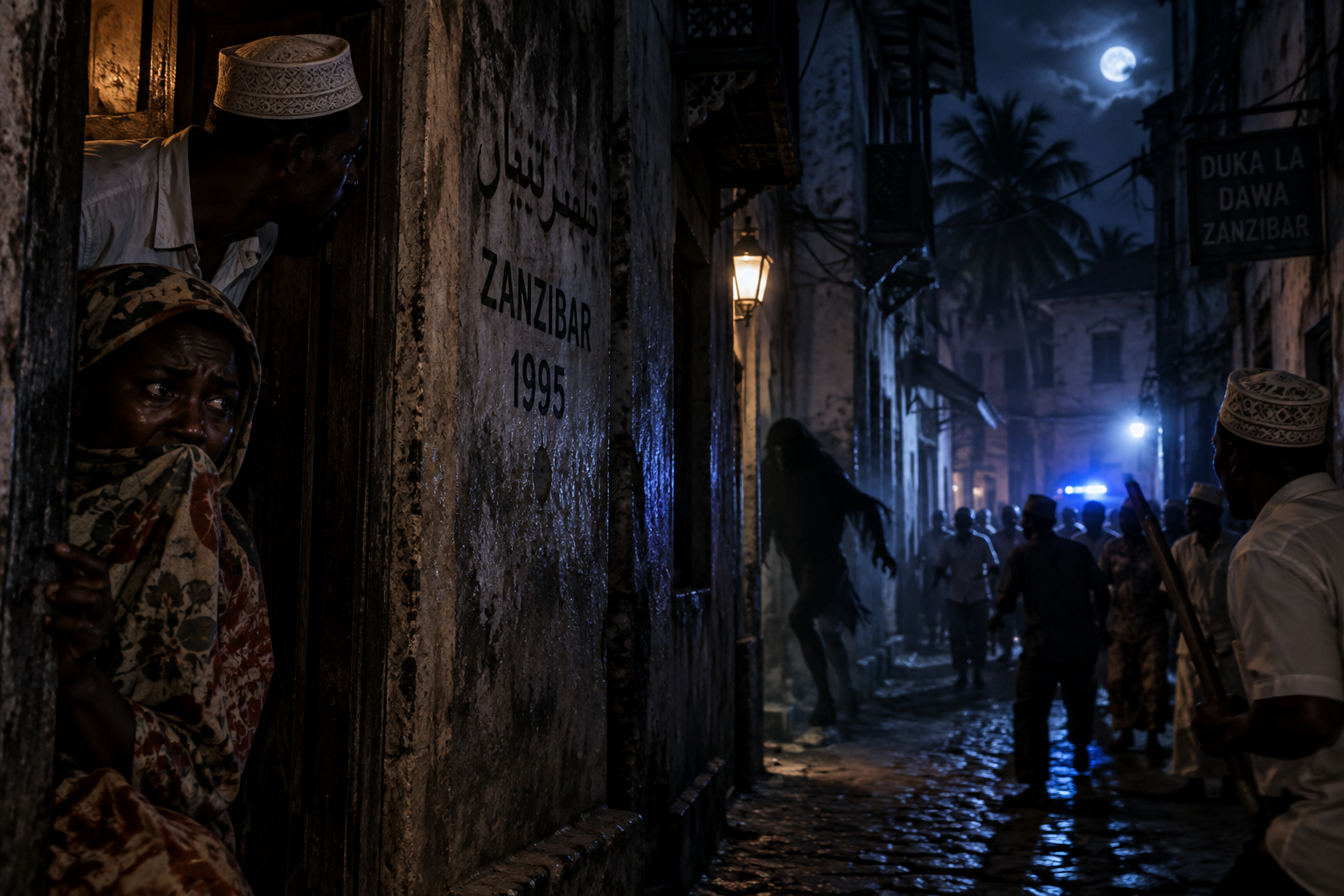
In March 1995, reports of the feared spirit Popobawa spread from Pemba Island to Unguja, the main island of Zanzibar. The panic became especially intense in Zanzibar Town, where residents described nocturnal attacks, paralysis, pressure on the body, foul smells and encounters with an entity said to change form or appear human. Unlike the earlier phase on Pemba, the Unguja outbreak was marked by more visible public disorder and several violent attacks on men accused of being Popobawa. The final dated reports occurred in late April and early May 1995.
Additional Notes
Reports began appearing in Zanzibar Town around 20 March 1995, as the earlier panic on Pemba was already beginning to decline. The phenomenon quickly became part of everyday conversation in the city, with residents exchanging stories of nighttime assaults, strange visitors and neighborhoods supposedly affected by the entity. The Unguja phase differed from the Pemba outbreak in one especially important respect: violence against suspected human manifestations of Popobawa became more severe. Martin Walsh documented four mob attacks on Unguja, three of which were reported to have resulted in deaths, although not every case could be fully corroborated. The best-known incident occurred during the night of 3 April 1995 in Zanzibar Town. A man believed by a crowd to be Popobawa was beaten to death. On the following morning, hundreds of people gathered outside the hospital mortuary after rumors spread that Popobawa had finally been killed. It was later announced that the victim was a man from mainland Tanzania who had come to Zanzibar for psychiatric treatment. Despite the death, reports continued almost immediately. Henriette Jansen, who was working at Zanzibar’s Ministry of Health at the time, recorded colleagues describing fresh nighttime incidents even while the crowd outside the mortuary celebrated the supposed death of Popobawa. One colleague said his wife had encountered a nearly naked young man inside their home, while others reported neighborhoods remaining awake because of renewed fear. The panic moved beyond Zanzibar Town during April. By around 14 April, reports were said to be shifting away from the city, and on 28 April another alleged Popobawa was reportedly killed at Nungwi in northern Unguja. The last dated incident in the 1995 chronology falls around 2 May. Descriptions of the entity remained inconsistent. Some people described a nearly naked human-like figure, others a dwarf-like creature with bat wings or claws, and many victims reported no visible form at all—only pressure, paralysis, fear or a strong unpleasant smell. This variability strongly supports treating the case as a spirit or folkloric panic rather than a conventional cryptid sighting. Researchers have linked the 1995 panic to several overlapping factors, including sleep paralysis, spirit beliefs, rumor transmission, social stress and political tension before Tanzania’s first multiparty elections. Martin Walsh has emphasized that the political interpretation became prominent only after other local explanations were already circulating. None of these explanations, however, resolves every reported experience or the striking way in which the stories spread across different communities. The identity and nature of Popobawa therefore remain open to interpretation.
The Location Today
Unguja, Zanzibar’s main island, remains home to Zanzibar City and many coastal and inland communities. The 1995 Popobawa panic involved reports from multiple locations, not a single preserved or officially designated visitor site.
- Environment
- Urban Area, Village / Rural Area, Island
- Time of Day
- Night
- Evidence Level
- Witness Report
- Visiting the Location
- Limited
- Ownership of the Location
- Mixed