
Summary
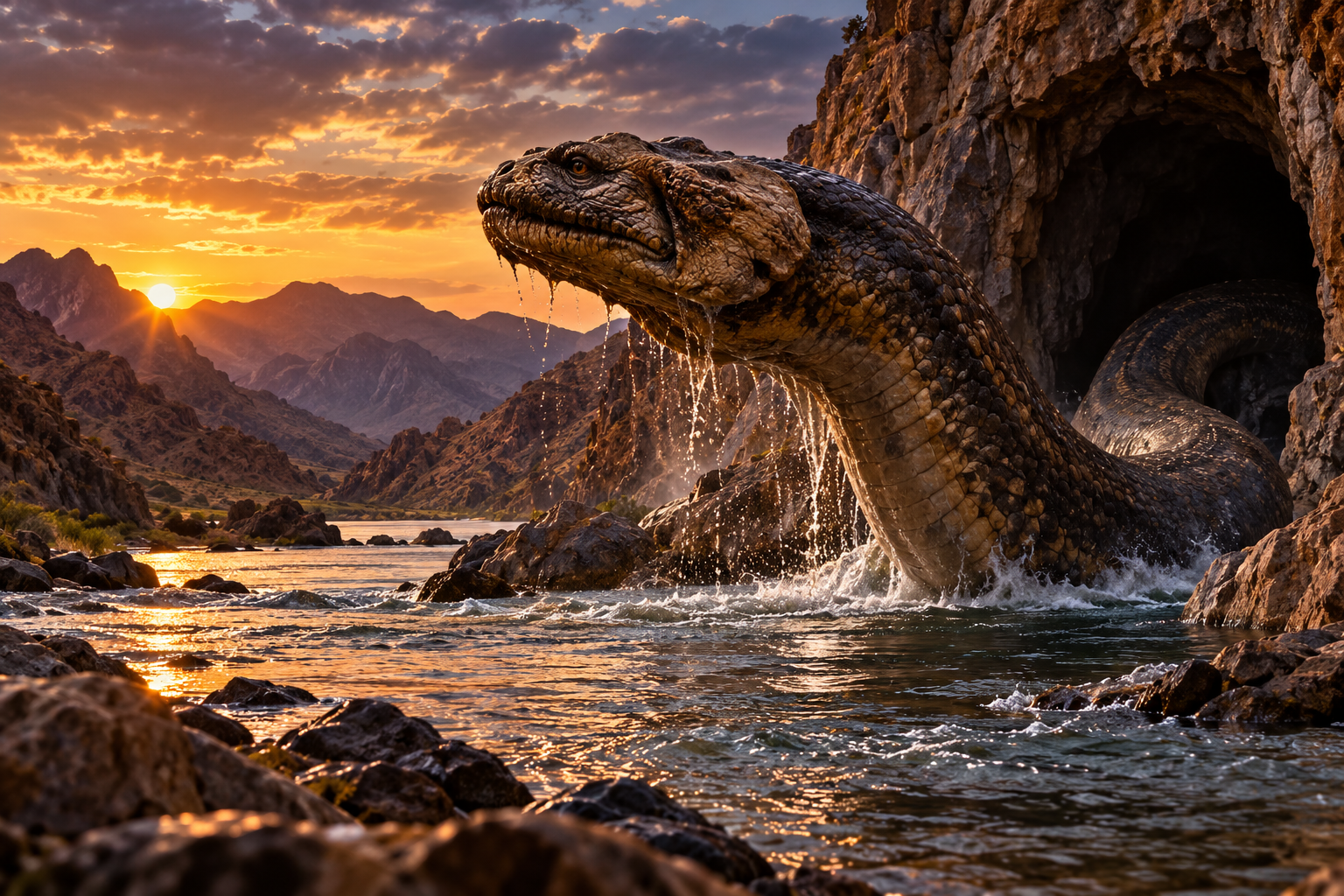
The Grootslang, meaning “great snake” in Afrikaans, is a legendary creature associated with South Africa's remote Richtersveld region near the Orange River. Early accounts describe an enormous serpent believed to inhabit rocky wilderness and dangerous riverbanks. Later versions portray it as a monstrous hybrid combining the body of a snake with features of an elephant, supposedly guarding diamonds inside a deep cavern known as the Wonder Hole. A frequently repeated story connects the creature to the disappearance of a treasure hunter in 1917, although that incident lacks reliable contemporary documentation. The Grootslang remains a creature of folklore, with no verified physical evidence establishing its existence.
Additional Notes
The Grootslang is one of southern Africa's most enduring legendary creatures. Its name comes from Afrikaans and means “great snake.” Although modern illustrations often depict a terrifying combination of elephant and serpent, the earliest documented accounts describe something simpler, yet no less frightening: an enormous snake believed to inhabit the remote Orange River region. One of the most valuable historical sources is Fred C. Cornell's The Glamour of Prospecting, published in 1920. Cornell described an expedition through the Richtersveld during which his local guide, Ezaak, became deeply concerned about camping beside the Orange River. According to Ezaak, a huge snake lived inside a large rock rising from the river. The creature was considered dangerous to both people and horses. Cornell wrote that local inhabitants and some European settlers claimed to have seen the animal, while others reported enormous tracks in the mud, allegedly around eighteen inches wide. Rather than leaving the area, Cornell and his companions decided to investigate. The following morning, they examined the riverbank but found no tracks. They even threw dynamite into the water near the suspected hiding place. When something moved inside a crack in the rock, the men opened fire. The supposed monster turned out to be an ordinary duck. Although the expedition produced no evidence of a giant serpent, Cornell's account demonstrates that belief in the Grootslang was already established in the region before his book appeared. Later versions of the legend became increasingly elaborate. The Grootslang was said to guard enormous deposits of diamonds inside a mysterious cavern called the Wonder Hole, sometimes described as the Bottomless Pit. Some accounts placed diamonds in the creature's eye sockets and suggested that the cave connected to distant underground passages. By the middle of the twentieth century, writers such as Lawrence G. Green had helped popularize these stories. The creature also acquired increasingly fantastic physical characteristics. Modern descriptions sometimes give it an elephant's head, trunk or tusks attached to a gigantic snake's body. These features are not prominent in Cornell's early account and appear to belong to the legend's later development. Another frequently repeated story concerns Peter Grayson, an alleged British treasure hunter who supposedly disappeared in the Richtersveld in 1917 while searching for diamonds. His disappearance is often attributed to the Grootslang. However, no reliable contemporary documentation has been established to confirm the expedition or connect it to the creature. The Grootslang remains an intriguing example of how regional oral traditions, dangerous wilderness, diamond prospecting and later cryptozoological interpretations can combine into a lasting mystery. No verified specimen, photograph or physical trace has demonstrated the existence of such an animal.
The Location Today
The Grootslang legend is associated with the rugged Richtersveld region and the Orange River along the South African–Namibian border. The landscape includes remote mountains, rocky valleys and isolated river sections. The legendary Wonder Hole is not reliably established as a publicly accessible, precisely mapped attraction, and no confirmed location of the creature's supposed dwelling is known. The legendary Wonder Hole is associated with Wondergat, a real limestone shaft near Cornellskop in South Africa's remote Richtersveld region. The shaft is reportedly approximately 44 metres deep. Explorations have revealed bats, but no evidence of the Grootslang or the legendary diamond treasures supposedly hidden within. Although Wondergat is a geographically identifiable location, access is restricted by the remote terrain and the hazards of entering a deep natural shaft. It is not a conventional tourist attraction, and entry should not be attempted without appropriate authorization, equipment and experienced guidance.
- Environment
- River, Mountain, Desert
- Time of Day
- Unknown
- Evidence Level
- Folklore
- Visiting the Location
- Unknown
- Ownership of the Location
- Mixed