
Summary
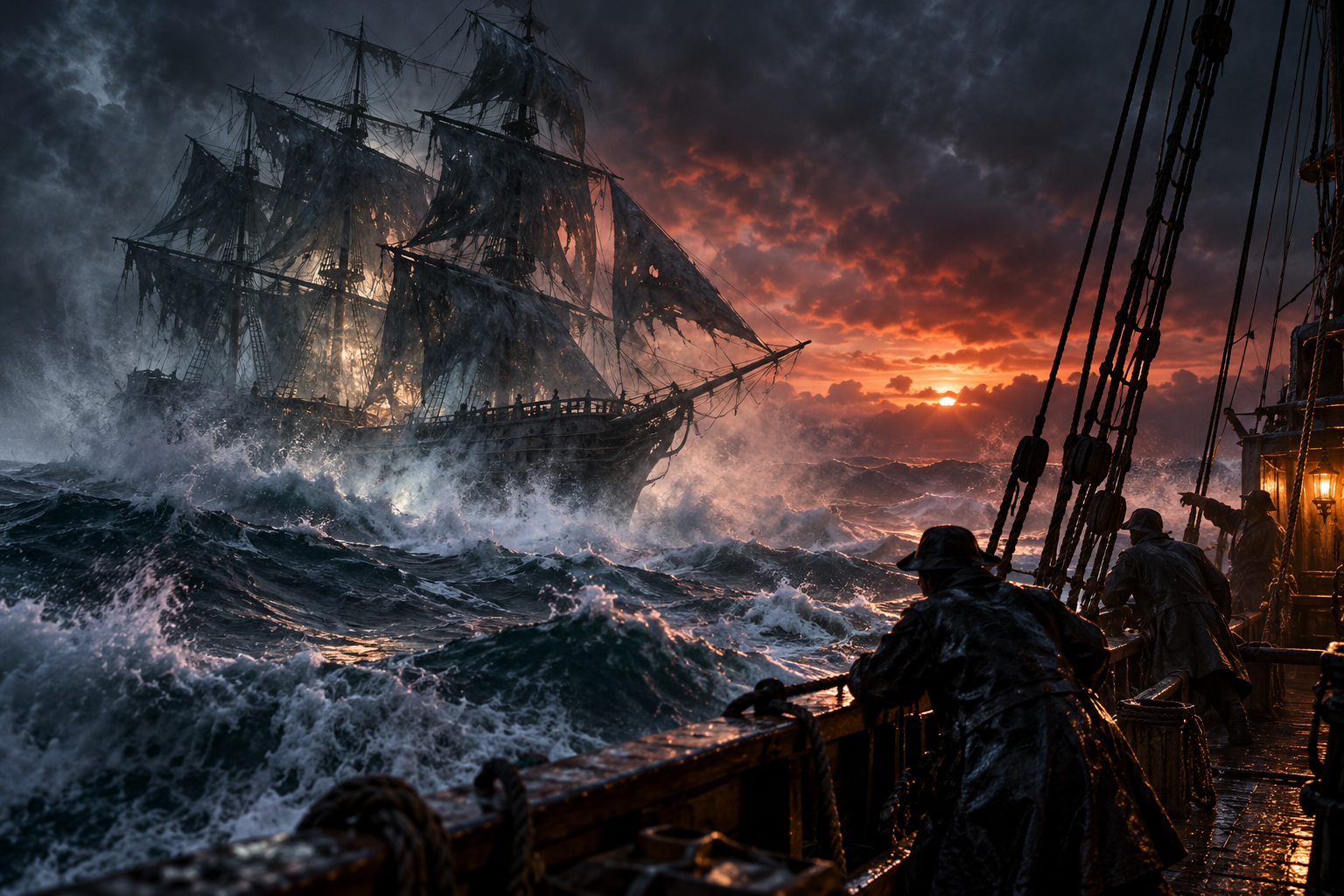
The Flying Dutchman is a centuries-old maritime legend associated with the waters around the Cape of Good Hope. By 1790, sailors were already telling of a lost Dutch vessel said to reappear during storms, although the origin and age of the tradition are unknown. Over time, the story developed into the familiar tale of a cursed captain condemned to sail forever. Later reports of mysterious ship-like apparitions added another layer to the legend, while atmospheric mirages have been proposed as a possible explanation for some sightings.
Additional Notes
One of the earliest known printed references to the Flying Dutchman appeared in 1790 in John MacDonald's account of his travels. While sailing near the Cape of Good Hope, MacDonald recorded that sailors spoke of a phantom known as the Flying Dutchman. According to the story, a Dutch vessel had been lost during severe weather after failing to reach harbour and was believed to reappear in storms. The way MacDonald described the tale suggests that the tradition was already familiar to sailors by that time. The legend became increasingly elaborate during the following decades. A 1795 account described a Dutch warship lost with its crew near the Cape and a later ship-like apparition seen during a storm. During the early nineteenth century, writers introduced supernatural punishment, wrongdoing and the idea of a captain condemned to continue sailing. The name Vanderdecken or van der Decken subsequently became closely associated with the captain, but there is no reliable evidence that the legendary figure represents a documented historical Dutch captain whose fate created the story. Reports interpreted through the legend continued long after its literary development. A published journal from a British royal voyage records an unusual incident on July 11, 1881, when thirteen people aboard reportedly observed a strange red light in which the masts, spars and sails of a brig appeared clearly visible. No vessel could subsequently be found. The journal identified the apparition as the Flying Dutchman. It also recorded that the sailor who first reported the sight later died after falling from the rigging, a coincidence that further reinforced the ominous character traditionally associated with the phantom ship. Atmospheric phenomena such as superior mirages and Fata Morgana can distort or displace the appearance of distant ships and provide a plausible explanation for some reports of vessels apparently floating or appearing where none should be visible. This does not establish a single explanation for the Flying Dutchman tradition, however. Its original inspiration remains unknown, and the legend developed through a mixture of sailors' folklore, literature and later sightings interpreted in the light of an already famous ghost-ship story. The witness count of 13 refers specifically to the reported July 11, 1881 sighting aboard HMS Bacchante. Other alleged sightings form part of the legend's history, but no reliable total number of witnesses can be established.
The Location Today
The legend is traditionally associated with the waters around the Cape of Good Hope on South Africa's Cape Peninsula. No single historical wreck site or exact location can be identified as the origin of the Flying Dutchman story. The Cape of Good Hope and surrounding coastal areas can be visited today, while the legendary sightings themselves are associated with the surrounding sea.
- Environment
- Coast / Beach, Ocean / Sea, Ship
- Time of Day
- Various times of day
- Evidence Level
- Folklore
- Visiting the Location
- Free Access
- Ownership of the Location
- Public