
Summary
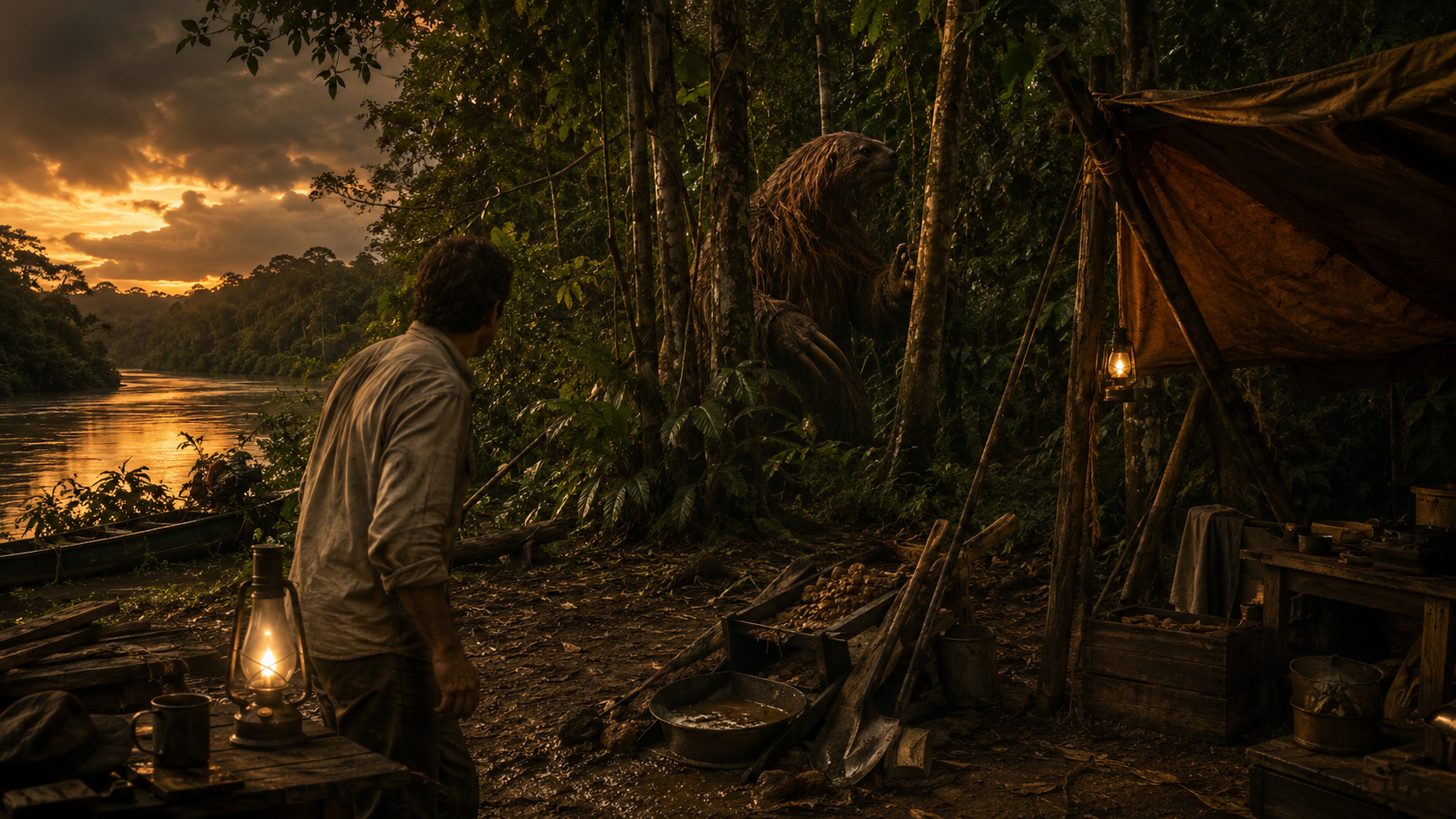
In 1975, Mário Pereira de Souza, who was working as a hunter for a mining camp along the Jamauchim River south of Itaituba in Pará, reported a frightening encounter with a large, long-haired creature later identified in Mapinguari accounts. According to his testimony, the animal screamed and approached him upright on its hind legs with an unsteady, swaying gait. He particularly remembered an overpowering foul odor that left him dizzy. The account later became one of the better-known modern Mapinguari reports collected by ornithologist David Oren during his investigation of the legend.
Additional Notes
The Tapajós region played an important role in David Oren’s development of the giant-ground-sloth hypothesis. Oren wrote that during his early fieldwork in the Brazilian Amazon he initially regarded the Mapinguari as purely mythical. Over time, however, he encountered stories from people in the Tapajós basin and elsewhere who claimed direct contact with the creature, prompting him to reconsider the reports as possible descriptions of an unknown large mammal. One of the most frequently cited Tapajós-area witnesses was Mário Pereira de Souza. In 1975 he was working as a hunter for a mining camp on the Jamauchim River, a tributary flowing into the Tapajós south of Itaituba. He recalled hearing a scream before seeing a large, long-haired animal moving toward him on its hind legs. He described the creature as swaying and unstable in its gait and emphasized the extremely powerful odor, which he said made him dizzy. The encounter reportedly affected Souza deeply, and later accounts state that he avoided returning to the rainforest afterward. David Oren interviewed him multiple times as part of his wider investigation of Mapinguari reports. The case became important not because of physical evidence, but because it provided a relatively detailed modern eyewitness description from the Tapajós basin. In his 1993 paper, Oren noted that by then he knew of no first-hand Mapinguari report from the Tapajós River basin that was less than about twenty years old. This makes the 1975 encounter especially useful as a historical anchor for the regional tradition, while also suggesting that later reports had become much rarer there. Oren believed that the more recent reports had shifted westward toward Acre and Amazonas. Oren proposed that the non-supernatural elements of Mapinguari descriptions might correspond to a surviving or recently extinct ground sloth, particularly a forest-adapted member of the mylodontid group. That hypothesis remains controversial and has never been confirmed by a specimen, DNA sample or other verified biological evidence.
The Location Today
The Tapajós region remains a vast Amazonian landscape of rivers, forests, communities and protected lands. The alleged Mapinguari encounter does not correspond to a verified, publicly marked location or visitor facility.
- Environment
- Forest, River
- Time of Day
- Unknown
- Evidence Level
- Witness Report
- Visiting the Location
- Unknown
- Ownership of the Location
- Unknown