
Summary
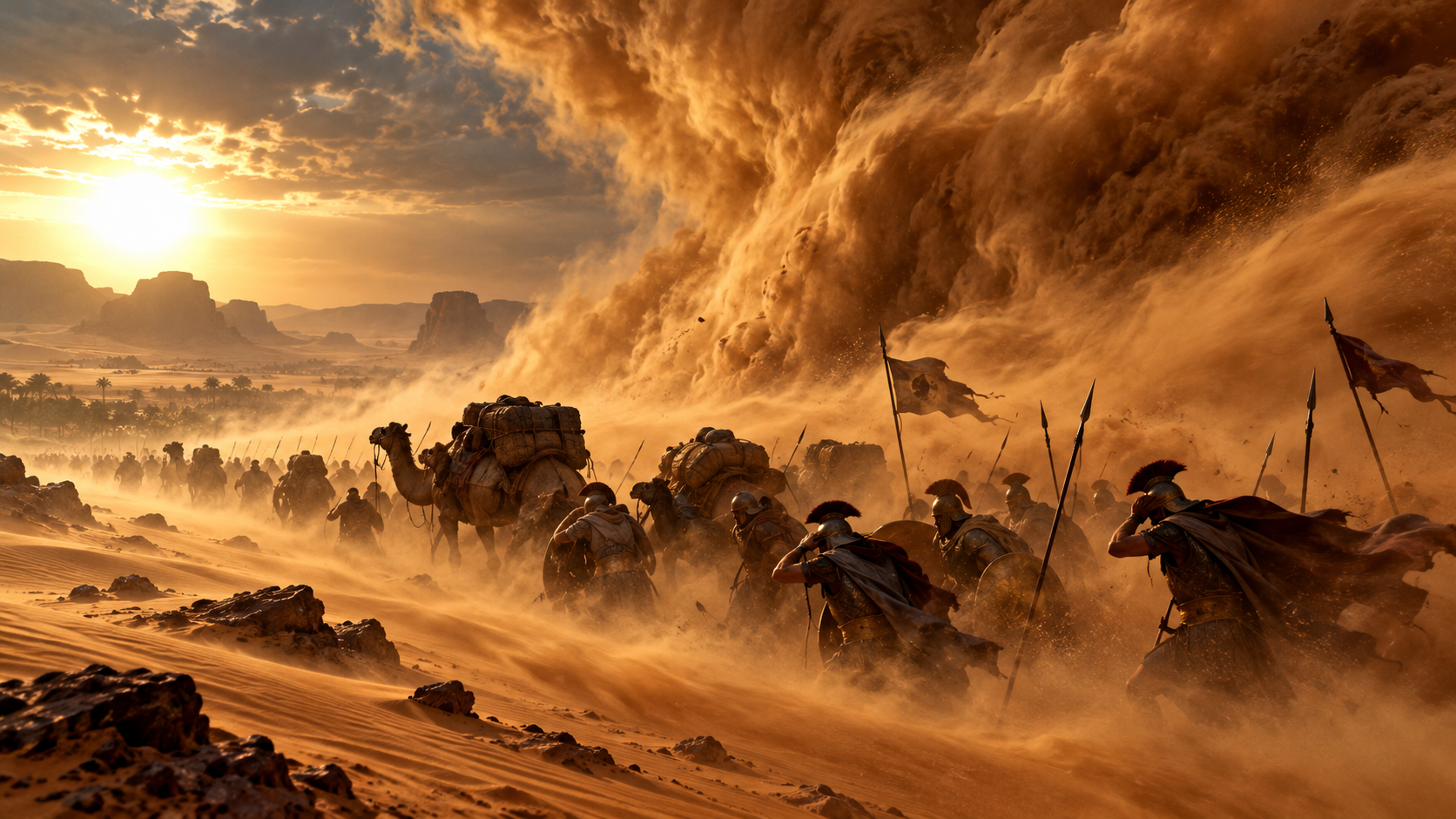
Around 524 BCE, Persian king Cambyses II reportedly sent an army of approximately 50,000 soldiers into Egypt's Western Desert to attack the Ammonians and their oracle. According to the ancient Greek historian Herodotus, the troops reached an oasis but never arrived at their destination or returned. Local tradition claimed that a violent desert wind buried the entire force beneath the sand. For centuries, explorers searched for traces of the missing soldiers. Modern archaeological discoveries at Dakhla Oasis have suggested a different possibility: the army may have been defeated during an Egyptian rebellion. The precise fate of the expedition remains uncertain.
Additional Notes
In 525 BCE, the Persian king Cambyses II conquered Egypt, bringing the country under Achaemenid rule. According to Herodotus, Cambyses subsequently ordered a military expedition into the Western Desert against the Ammonians, whose oracle was an important religious centre. Herodotus described a force of approximately 50,000 soldiers departing from Thebes with local guides. After travelling for seven days, the expedition reportedly reached an oasis. Beyond that point, its fate became a mystery. The historian recorded a story attributed to the Ammonians: while the Persian soldiers were taking their morning meal somewhere in the desert, a powerful wind arose from the south. Carrying enormous quantities of sand, the storm supposedly overwhelmed and buried the entire army. None of the soldiers returned. This dramatic account became one of antiquity's most enduring disappearance legends. The image of thousands of armed men vanishing beneath shifting dunes inspired centuries of speculation and searches for archaeological remains. Yet the story presents considerable historical difficulties. Herodotus wrote decades after the alleged event and did not claim to have witnessed it. The army's reported strength, precise route, and ultimate destination remain uncertain. In 2014, Egyptologist Olaf Kaper drew attention to archaeological discoveries at Amheida in Dakhla Oasis, where inscriptions demonstrated the importance of an Egyptian rebel ruler, Petubastis, during the early Persian period. Kaper proposed that the missing Persian force may have encountered Egyptian resistance and suffered a military defeat rather than perishing in a sandstorm. This interpretation offers a historically grounded alternative, although the exact circumstances of the expedition have not been conclusively reconstructed. The Lost Army of Cambyses II therefore occupies a fascinating position between ancient historiography, desert legend, and modern archaeological investigation. Whether the original story preserves the memory of a military disaster, a natural catastrophe, or a transformed political event remains a subject of historical debate.
The Location Today
The alleged disappearance took place somewhere in Egypt's vast Western Desert, but no confirmed archaeological site has been identified as the location where Cambyses' army vanished. The traditional narrative connects the expedition with an ancient route from Thebes through an oasis towards the Ammonians, commonly associated with Siwa. Modern archaeological research has also drawn attention to Dakhla Oasis, where evidence of resistance to Persian rule has been discovered. Today, the region contains remote desert landscapes, historic oases, and archaeological sites. There is no verified battlefield or mass burial site belonging to the missing expedition, and no designated visitor attraction marking the army's disappearance.
- Environment
- Desert
- Time of Day
- Morning (according to the legend)
- Evidence Level
- Folklore
- Visiting the Location
- Unknown
- Ownership of the Location
- Unknown