
Summary
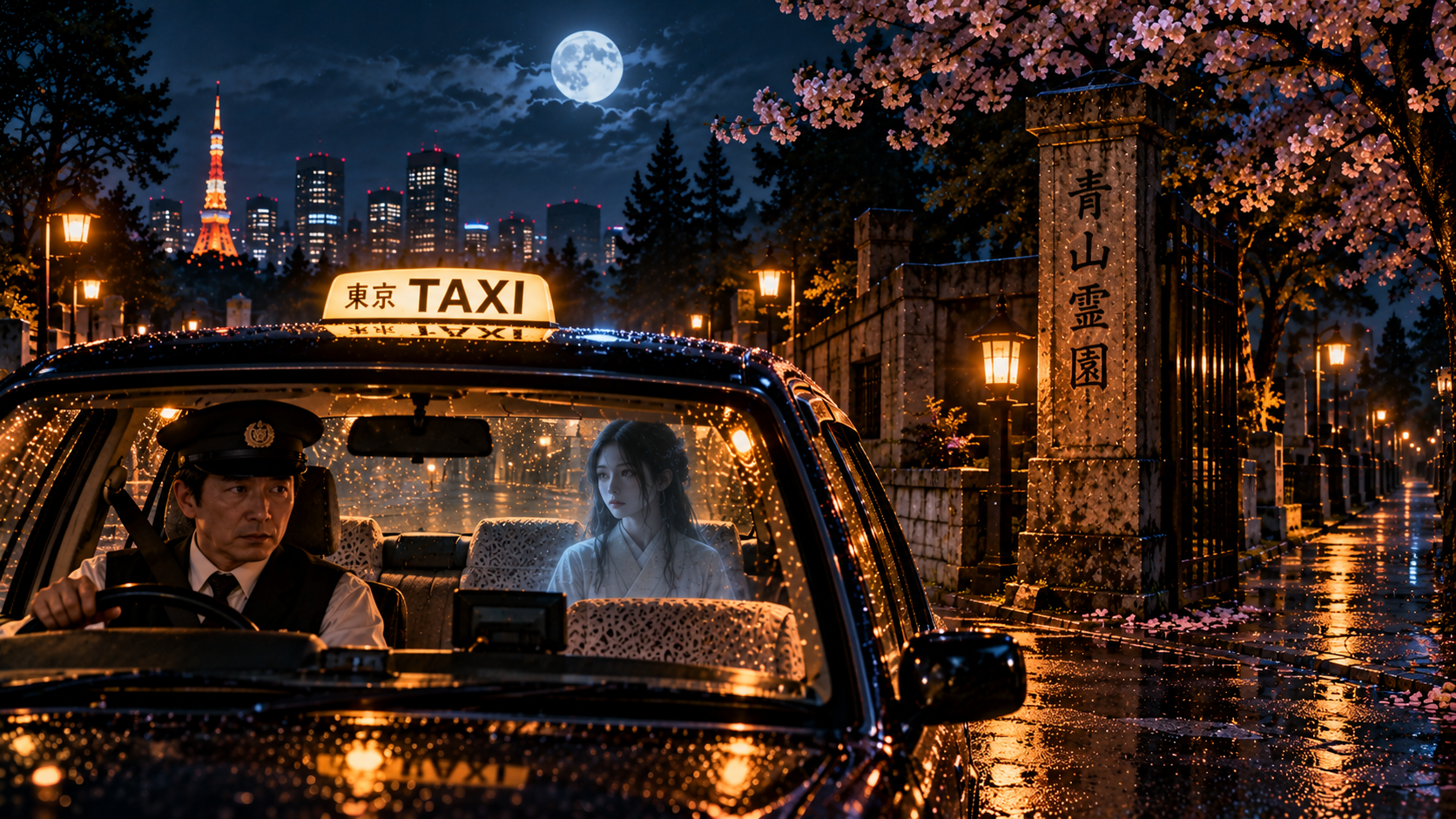
An eerie Japanese legend tells of a taxi driver who picked up a young woman near Aoyama Cemetery in Tokyo late at night. Dressed in a traditional kimono, she requested a journey to Yokohama. During the drive, however, the driver reportedly discovered that his passenger had mysteriously disappeared from the back seat. In some versions, the journey ended with the disturbing revelation that the woman had already died. The story was documented by Japanese folklorist Yasaburō Ikeda in 1962, who recalled hearing it around 1930 or 1931. The tale remains an early example of Japan's enduring phantom taxi legends.
Additional Notes
Aoyama Cemetery, one of Tokyo's oldest burial grounds, is the setting of a ghost story that has circulated in Japan for generations. According to the legend, a taxi driver travelling near the cemetery late at night noticed a young woman waiting beside the road. She was dressed in a traditional kimono and appeared to be looking for transportation. When the driver stopped, the woman entered the taxi and asked to be taken to Yokohama, a city south of Tokyo. The journey began without incident. His passenger remained quiet, and the driver continued through the darkened streets, occasionally checking his rear-view mirror. At some point during the journey, however, he noticed something unsettling: the woman was no longer visible in the back seat. She had apparently disappeared without opening a door or leaving any indication of where she had gone. The story exists in several variations. In some, the passenger vanishes during the journey, leaving the driver bewildered. In others, he reaches the requested destination and learns that the young woman he had transported was already dead. The precise sequence of events differs between retellings, but the central mystery remains the same: a passenger enters an ordinary taxi and disappears under seemingly impossible circumstances. The association with Aoyama Cemetery gives the tale a particularly haunting setting. Established in 1874, the cemetery contains thousands of graves and has long been a prominent landmark in Tokyo. Its quiet avenues, particularly after dark, provide a memorable backdrop for a story involving a mysterious passenger whose destination may have been connected to her former life. The legend has a documented history. Japanese folklorist Yasaburō Ikeda included the Aoyama taxi story in his 1962 book *Nihon no Yūrei* (*Japanese Ghosts*). He stated that he had heard the account around 1930 or 1931, suggesting that the story was already circulating during the early Shōwa period. However, the approximate date refers to when Ikeda encountered the story, not to a confirmed incident. No contemporary newspaper report, police record or identifiable taxi driver has been established for the original Aoyama account. Its supernatural elements therefore remain part of an oral tradition rather than verified historical events. The story belongs to the wider *vanishing hitchhiker* tradition, found in many countries, in which a mysterious passenger disappears from a vehicle and is sometimes later identified as someone who has died. Japan developed several distinctive versions of this motif, often involving taxis, cemeteries and quiet nighttime roads. One particularly notable example emerged in Kyoto in 1969, when a taxi driver reportedly described a disappearing passenger near Midorogaike Pond. Unlike the older Aoyama legend, that incident was documented in a contemporary newspaper report. The Aoyama Cemetery story remains significant as an early recorded Japanese version of the phantom passenger legend. Whether it originated from an unusual real-life experience or developed entirely through storytelling is unknown. What has endured is the unsettling image of a driver looking into his rear-view mirror and discovering that the passenger he had just collected is no longer there.
The Location Today
Aoyama Cemetery is a historic public cemetery in Minato City, central Tokyo. Established in 1874, it covers approximately 26 hectares and contains the graves of numerous prominent Japanese historical figures. The cemetery remains open to visitors and is also known for its cherry blossom trees. The ghost-taxi legend is associated with roads around the cemetery, but no exact pickup location can be verified. Visitors should respect the cemetery's active use as a burial ground.
- Environment
- Urban Area, Road, Cemetery
- Time of Day
- Night
- Evidence Level
- Folklore
- Visiting the Location
- Free Access
- Ownership of the Location
- Public