
Summary
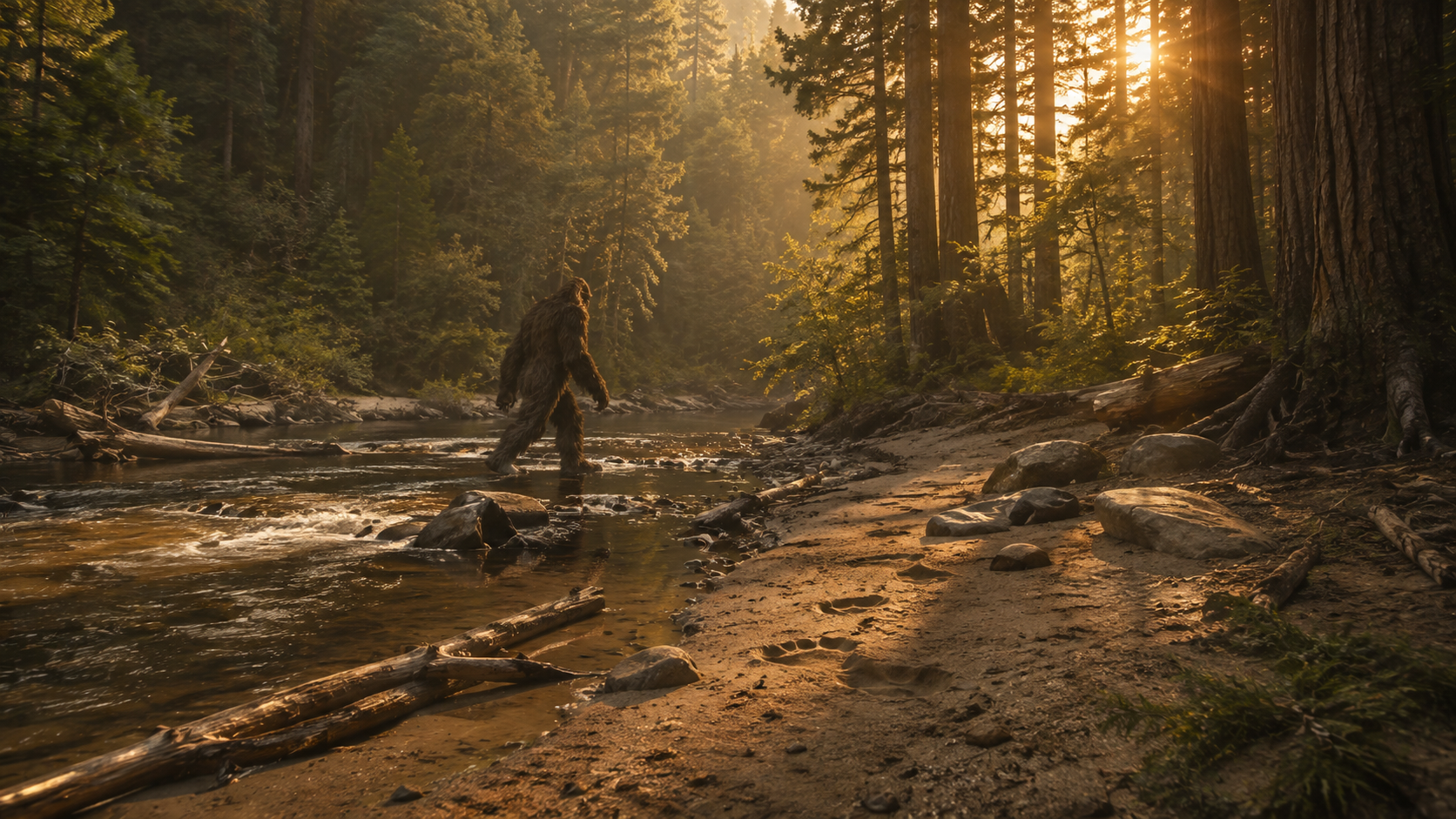
Bluff Creek became one of the defining locations of the modern Bigfoot legend after enormous human-like footprints were reported near a logging operation in 1958. Nine years later, Roger Patterson and Bob Gimlin encountered and filmed a large, dark, bipedal figure walking across a creek-side clearing nearby. The short 16 mm film became the most famous visual evidence associated with Bigfoot and remains disputed, with interpretations ranging from an unknown primate to a person in a costume.
Additional Notes
The 1958 Bluff Creek footprint reports played a major role in creating the modern Bigfoot phenomenon. After logging workers discovered unusually large tracks, Humboldt Times coverage spread the story far beyond Northern California and helped popularize the name “Bigfoot.” Jerry Crew famously brought a plaster cast of one of the prints to the newspaper. On October 20, 1967, Roger Patterson and Bob Gimlin were riding through the Bluff Creek area while searching for evidence of Sasquatch when they reported encountering a large, hair-covered figure. Patterson captured a short sequence on 16 mm film as the figure crossed an open area and disappeared into the trees. The subject, later nicknamed “Patty,” appears to turn briefly toward the camera while walking away. The 1958 footprints gained a major complication after road contractor Ray Wallace died in 2002. His family said Wallace had created some of the famous tracks using large carved wooden feet, and matching wooden feet were produced. This casts serious doubt on parts of the original footprint story, although it does not by itself establish what appears in Patterson’s separate 1967 film.Decades later, the Bluff Creek Project relocated and surveyed the original film site. Researchers identified surviving trees, stumps and other landscape features visible in historical photographs, allowing them to reconstruct the approximate camera position and the path taken by the filmed figure. Their survey closely matched a 1971 photograph of the site, while Bob Gimlin's own recollection of the encounter location reportedly differed from the reconstructed position by only about 20 feet.
The Location Today
Bluff Creek remains a remote forested watershed in northern California. The surrounding Six Rivers National Forest has public recreation areas, including a designated access trail near the creek’s confluence with the Klamath River. This does not establish public access to the exact historic encounter sites.
- Environment
- Forest
- Time of Day
- Various
- Evidence Level
- Investigated Case
- Visiting the Location
- Limited
- Ownership of the Location
- Unknown