
Summary
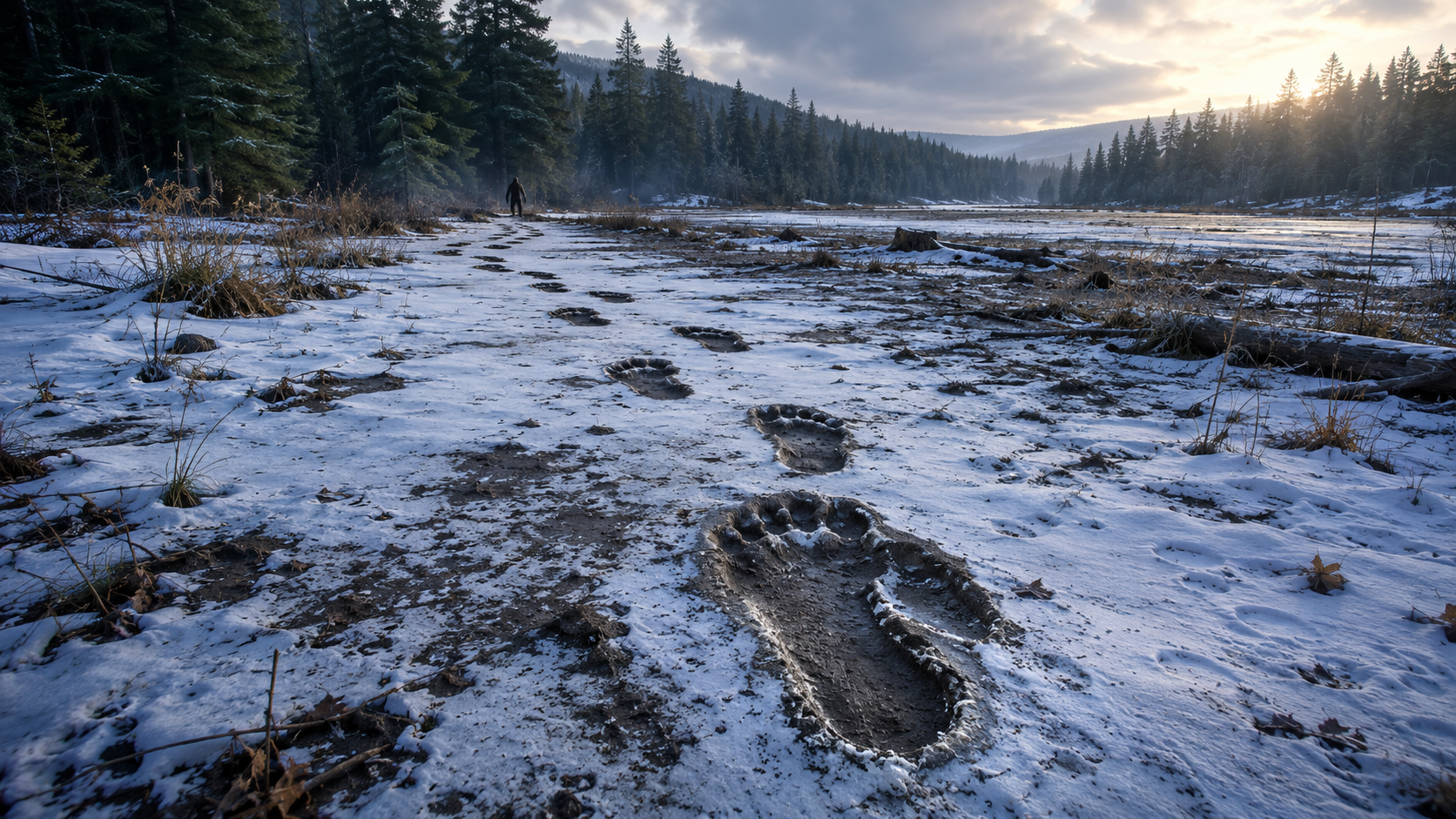
In late 1969, a series of unusually large human-like footprints was discovered near the abandoned mining town of Bossburg, Washington. The tracks became famous because the right foot appeared severely deformed, earning the alleged creature the nickname “Cripplefoot.” On December 13, researchers documented a trackway reportedly containing 1,089 footprints through snow and mud near Lake Roosevelt. Casts and photographs were later examined by several prominent Bigfoot researchers and anthropologists, but the origin of the tracks remains disputed.
Additional Notes
The first notable tracks were reported on November 24, 1969, when Joe Rhodes found large footprints near the Bossburg town dump. The right footprint showed an unusual deformity, while the left appeared more normal. The discovery attracted Bigfoot researchers including René Dahinden, Bob Titmus and Ivan Marx. After further searches, Dahinden and Marx reported finding a much longer trackway on December 13. Their field documentation recorded 1,089 individual tracks, some crossing snowy and muddy terrain near the Columbia River/Lake Roosevelt area. The prints were photographed and several were cast in plaster. Physical anthropologist Grover Krantz became particularly interested in the deformed foot. He argued that the shape appeared anatomically consistent with a genuine injury or congenital deformity rather than a simple carved wooden footprint. Primatologist John Napier also examined material from the case, while later Bigfoot researcher Jeff Meldrum considered the anatomy unusually detailed for a casual fabrication. These assessments were supportive, not definitive proof of an unknown primate. The Bossburg case also attracted hoaxes and sensational claims soon after the discovery, including fake footage and stories of a captured Bigfoot. This complicates the history of the case, but the original casts and photographs of the Cripplefoot tracks remain among the most discussed pieces of physical evidence in Bigfoot research.
The Location Today
Bossburg remains a small settlement in northeastern Washington. The reported 1969 footprint finds are associated with the surrounding area, but there is no verified preserved footprint site or designated visitor attraction.
- Environment
- Forest
- Time of Day
- Various
- Evidence Level
- Investigated Case
- Visiting the Location
- Unknown
- Ownership of the Location
- Unknown