
Summary
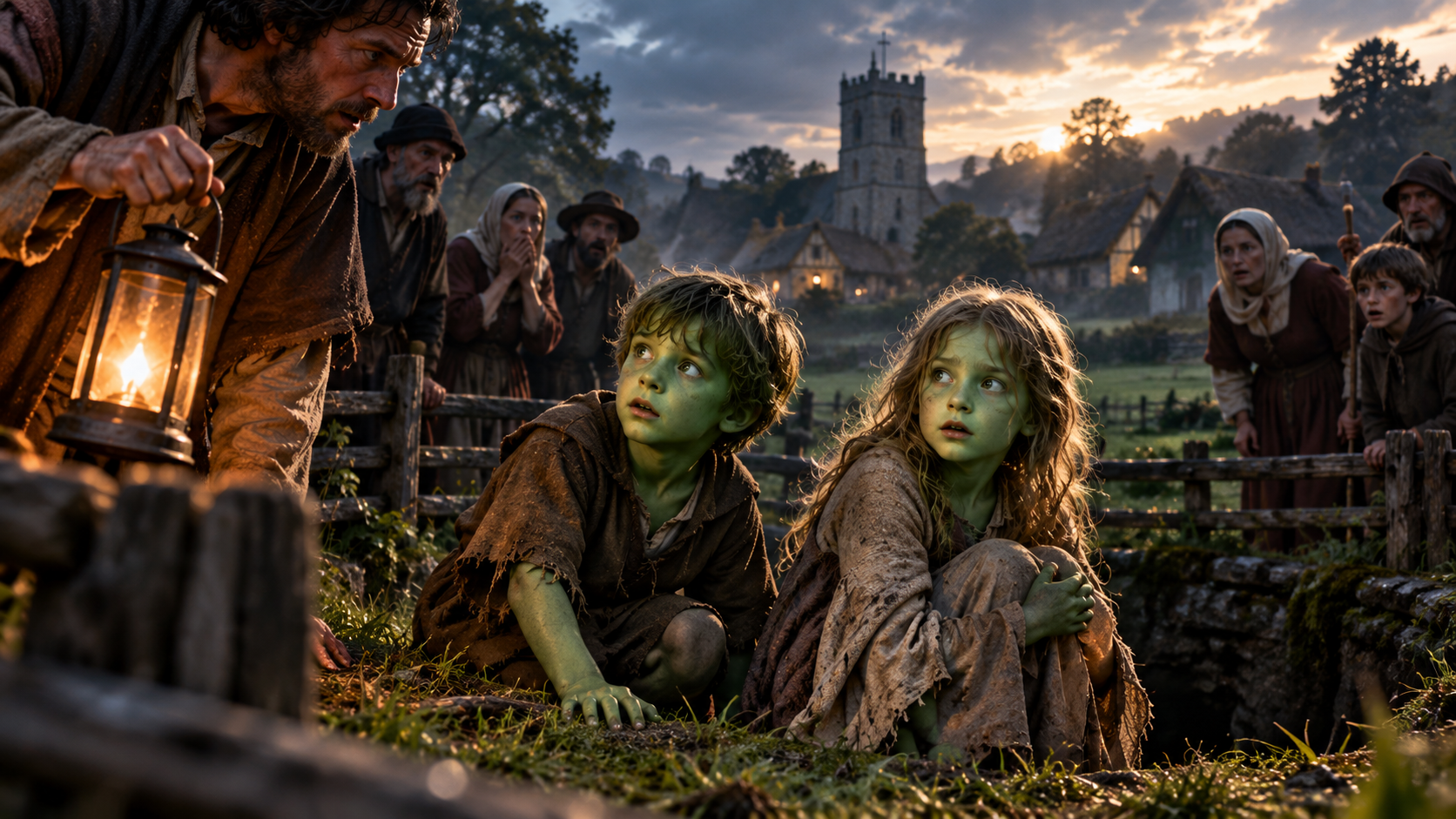
During the 12th century, two children with unusually green skin reportedly appeared near a wolf pit in the English village of Woolpit, Suffolk. The boy and girl spoke an unfamiliar language, wore strange clothing, and initially refused ordinary food, accepting only beans. They were reportedly taken into the household of a local landowner, Richard de Calne. Over time, their green colouring faded, but the boy became ill and died. The girl survived, learned English, and described a mysterious homeland called St Martin's Land, where the sun never shone brightly. The story survives in two medieval chronicles, although its historical authenticity remains uncertain.
Additional Notes
The story of the Green Children of Woolpit is one of England's most intriguing medieval mysteries. It is preserved in the writings of two chroniclers: William of Newburgh, author of *Historia rerum Anglicarum*, and Ralph of Coggeshall, author of *Chronicon Anglicanum*. The reported incident is traditionally placed during the reign of King Stephen of England (1135–1154), although neither a precise date nor an independently verified contemporary record of the children's discovery is known. According to the accounts, villagers working near Woolpit discovered two children, a boy and a girl, emerging from an area associated with a wolf pit. Their skin was an unusual green colour, their clothing was unfamiliar, and their speech could not be understood. The children were brought to the household of Richard de Calne, a local landowner. They initially rejected the food offered to them. When they discovered green beans, however, they ate them eagerly. Eventually, they became accustomed to ordinary food, and their green colouring gradually disappeared. The boy reportedly remained weak and died. The girl survived, learned English, and was later able to describe her supposed homeland. She called it St Martin's Land, a place where everything was said to have a greenish appearance and where daylight resembled perpetual twilight. Its inhabitants were Christians and possessed churches, but the sun never rose high enough to illuminate the land brightly. The girl explained that she and her brother had been tending their father's animals when they heard the sound of bells. Following the sound, they entered a mysterious passage or cavern and eventually emerged into the unfamiliar brightness of the English countryside. The two medieval chroniclers differ in certain details. Ralph of Coggeshall's version includes information attributed to Richard de Calne, while William of Newburgh presents the story as something he had learned from supposedly reliable informants. Several explanations have been suggested over the centuries, including the possibility that the children were foreign migrants whose language was unfamiliar to local villagers. Nutritional deficiencies have also been proposed as a possible explanation for the unusual skin colour. However, none of these theories has been established as the historical explanation for the story. Although the chronicles demonstrate that the account circulated in medieval England, they cannot establish whether the children actually existed or whether their extraordinary experiences occurred as described. Their alleged homeland, St Martin's Land, remains a particularly mysterious element of the tradition.
The Location Today
Woolpit remains an inhabited village with a strong connection to the Green Children legend. The story is represented on the village sign, and the Woolpit Museum maintains an exhibition about the children. The museum provides a modern opportunity to explore the tradition, although no physical evidence of the children's alleged appearance has been established. The exact location of the alleged discovery of the two children is unknown.
- Environment
- Field / Farmland, Village / Rural Area
- Time of Day
- Unknown time of day
- Evidence Level
- Folklore
- Visiting the Location
- Not Applicable
- Ownership of the Location
- Mixed