
Summary
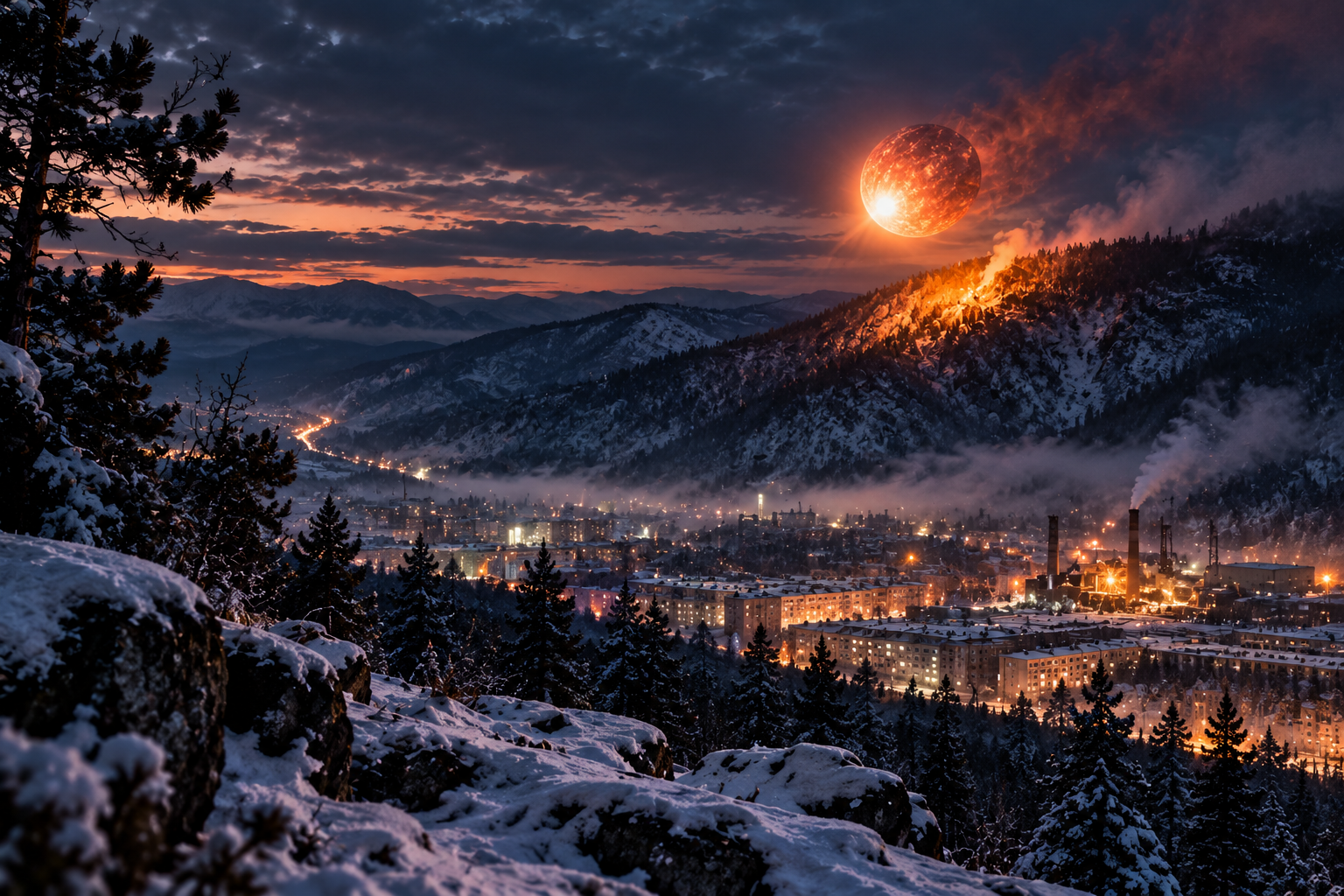
On the evening of January 29, 1986, residents of Dalnegorsk in the Soviet Union reportedly witnessed a reddish, glowing sphere moving across the sky toward Height 611, a hill overlooking the town. The object appeared to descend onto the mountainside, where witnesses later described a fire or persistent glow. Investigators subsequently examined the site and reported unusual material residues, including small metallic particles, glass-like fragments and signs of intense heating. Some researchers interpreted the findings as evidence of an unidentified aerial object's crash, while others questioned the observations and the origin of the recovered materials. No independently verified explanation has established what caused the incident.
Additional Notes
On January 29, 1986, at approximately 7:55 PM, residents of Dalnegorsk, a mining town in the Soviet Far East, reportedly noticed a bright reddish-orange sphere moving silently across the winter sky. Witnesses described an object with an apparent size of roughly half the full Moon. According to later accounts, it travelled unusually slowly and appeared to move almost parallel to the ground rather than following the steep trajectory normally associated with a falling meteor. As it approached Height 611, also known as Mount Izvestkovaya, the glowing sphere reportedly changed its movement before descending toward the hillside. Some witnesses described a sudden drop, while others recalled a brief change in altitude. A fire-like glow was subsequently observed near the summit and allegedly remained visible for approximately one hour. The mystery deepened when a research team led by Valery Dvuzhilny examined the mountain several days later. Investigators reported finding a small area of approximately two by two metres showing signs of intense heating. Rock fragments appeared blackened, and pieces of charred wood were recovered from the site. More unusual were the reported microscopic residues: tiny metallic droplets, glass-like particles and delicate mesh-like structures. The materials attracted the attention of researchers, who subjected selected samples to laboratory analysis. A technical study published in 1991 described lead particles and charred wood attributed to Height 611. However, some later retellings incorrectly combined these findings with analyses of objects recovered at entirely different locations, including an iron sphere from the Kerch Peninsula. This distinction is crucial. Although certain samples were scientifically examined, the available records do not establish an uninterrupted chain of custody proving that every analysed particle originated at Height 611 or resulted from the object seen in January 1986. Various explanations have been proposed, including a meteor, atmospheric phenomena, rocket debris, a balloon or industrial contamination. Dalnegorsk's extensive mining and industrial activity makes the environmental origin of some materials particularly relevant. Nevertheless, no explanation has been conclusively demonstrated from the available documentation. The incident became one of the Soviet Union's best-known alleged UFO crash cases, sometimes nicknamed “Russia's Roswell.” Yet its central mystery remains more limited and scientifically interesting than that nickname suggests: What did the witnesses see, what caused the reported fire, and were the recovered materials actually connected to the event?
The Location Today
Height 611, also known as Mount Izvestkovaya, remains a recognizable hill overlooking Dalnegorsk in Russia's Primorsky Krai. The surrounding area is part of an industrial and mountainous landscape. The reported impact site is associated with the upper slopes, but the exact position of the original sampling area is not securely established in the publicly available documentation.
- Environment
- Mountain, Urban Area
- Time of Day
- Evening, approximately 7:55 PM
- Evidence Level
- Investigated Case
- Visiting the Location
- Unknown
- Ownership of the Location
- Unknown