
Summary
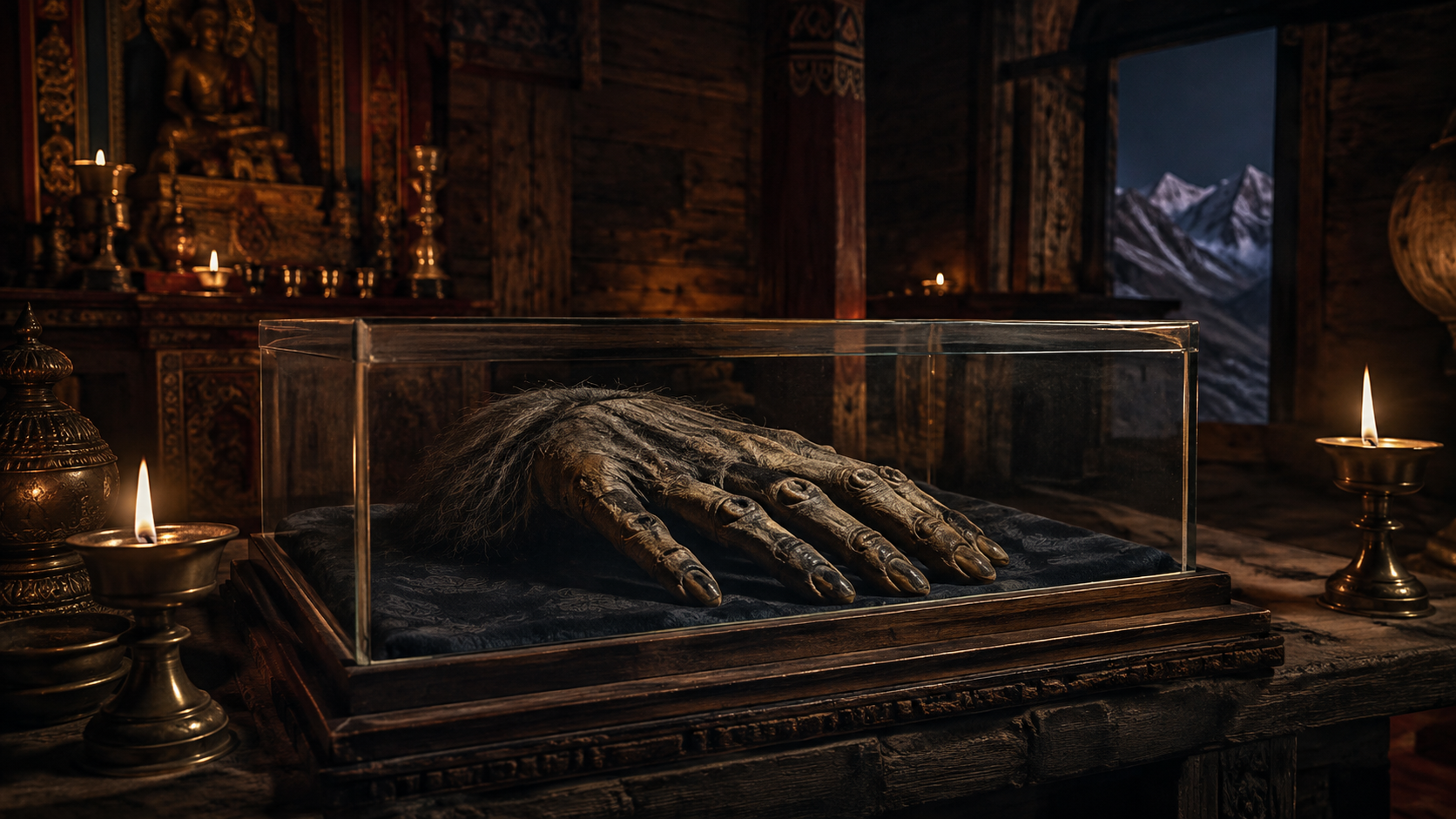
At Pangboche Monastery in Nepal’s Khumbu region, a mummified hand long preserved as a sacred relic was presented as possible evidence of the Yeti. The object gained international notoriety after parts of it were removed in 1958 for scientific study. Later examination did not confirm an unknown Himalayan primate. A finger attributed to the hand was ultimately tested for DNA in 2011 and found to be human, making the Pangboche relic one of the most famous and controversial pieces of alleged Yeti evidence.
Additional Notes
According to local monastery tradition, the Pangboche hand was an ancient sacred relic associated with Yeti folklore and the religious history of the region. In local belief, such objects were not merely curiosities but ritual items connected to the monastery’s protection and good fortune. The hand entered Western Yeti lore in the late 1950s, when explorer Peter Byrne encountered it at Pangboche during expeditions linked to Tom Slick’s Yeti investigations. Byrne later arranged for finger material from the relic to be removed for scientific examination, and the story became even more famous because actor James Stewart was said to have helped smuggle the specimen out of the region. Subsequent examination did not establish the hand as evidence of an unknown ape. Later accounts connected with Edmund Hillary’s investigations concluded that the Pangboche hand was composed of human bones. Decades afterward, a surviving finger fragment in museum holdings was DNA-tested by Dr. Rob Ogden in Edinburgh, and the result indicated human origin. The story took another turn when the complete hand was reportedly stolen from Pangboche Monastery in the early 1990s. Replicas were later created and returned, so the case remains notable not only as alleged Yeti evidence, but also as a strange mixture of Himalayan folklore, scientific inquiry and artifact loss.
The Location Today
Pangboche is a Himalayan village with a monastery historically associated with a purported Yeti hand. The relic’s reported history is disputed, and visitors should not assume that the original object remains on display.
- Environment
- Mountain, Village / Rural Area
- Time of Day
- Various
- Evidence Level
- Investigated Case
- Visiting the Location
- Limited
- Ownership of the Location
- Unknown