
Summary
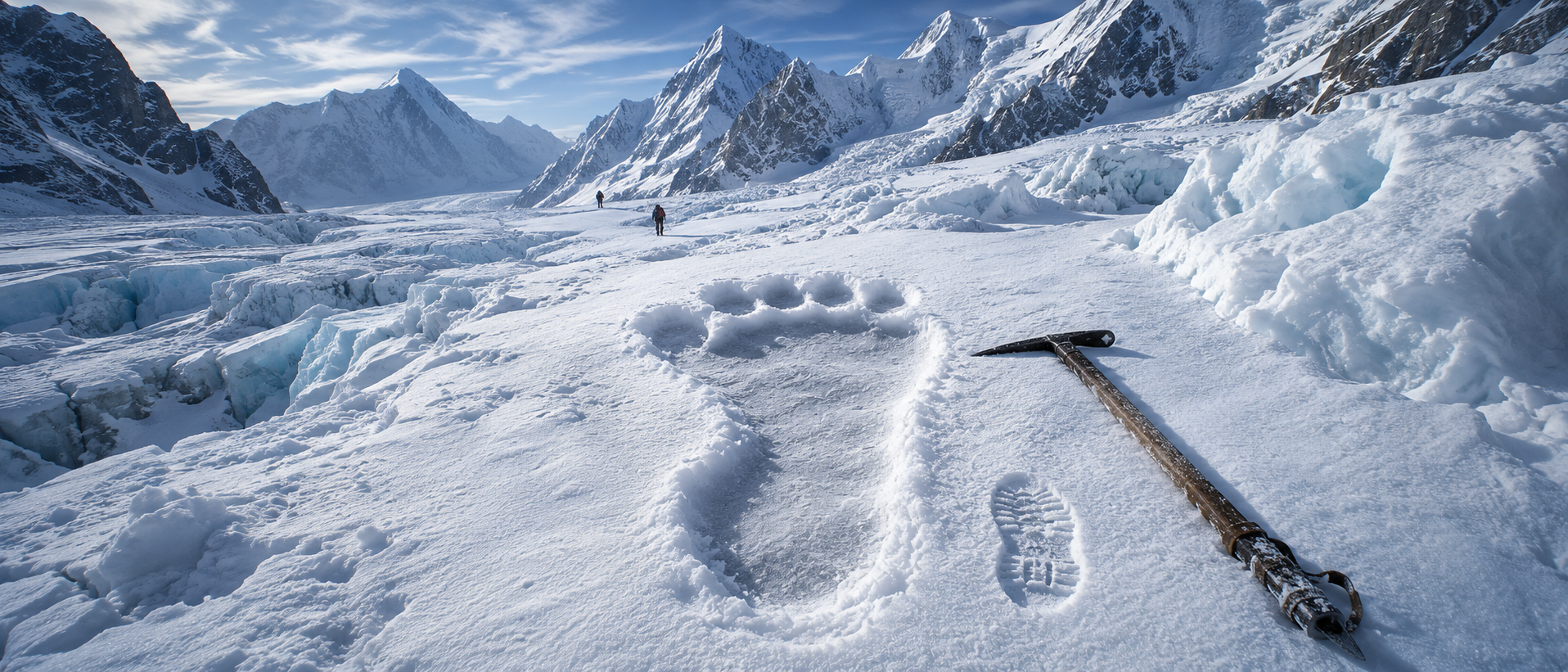
In November 1951, British mountaineer Eric Shipton and his companions discovered a line of unusually large footprints in snow on the Menlung Glacier near the Nepal–Tibet frontier. Shipton photographed several of the tracks, including one remarkably clear print beside an ice axe for scale. The images became some of the most famous physical evidence ever associated with the Yeti and helped transform the “Abominable Snowman” from Himalayan folklore into an international mystery.
Additional Notes
Shipton, physician and mountaineer Michael Ward, and Sherpa Sen Tenzing encountered the tracks while returning from the 1951 British reconnaissance of Mount Everest. Ward later recalled that the prints continued for a considerable distance across the glacier, with some impressions sharply preserved in thin snow while others had already been enlarged or distorted by melting. The clearest print was around 12–13 inches long and considerably broader than Ward’s climbing boot. Shipton photographed it beside an ice axe and a boot for scale. The unusual shape appeared to show several toes and a broad side projection, giving it a distinctly primate-like appearance. The tracks themselves were not dismissed as fabricated. The debate has instead focused on what produced them. Shipton noted that melting had clearly distorted many impressions, and later researchers proposed that ordinary animal tracks could have expanded or changed shape in the snow. Michael Ward himself later explored anatomical and developmental explanations for the unusual footprint shape. Whatever their origin, the photographs had enormous cultural impact. They became perhaps the most iconic images in Yeti history and helped fuel the wave of Himalayan expeditions and investigations that followed during the 1950s and 1960s.
The Location Today
The Menlung Glacier area remains remote high-altitude Himalayan terrain. The reported 1951 footprints were documented during an expedition, and no maintained public display or reliably identifiable visitor stop exists at the historic footprint location.
- Environment
- Mountain
- Time of Day
- Day
- Evidence Level
- Investigated Case
- Visiting the Location
- Limited
- Ownership of the Location
- Unknown