
Summary
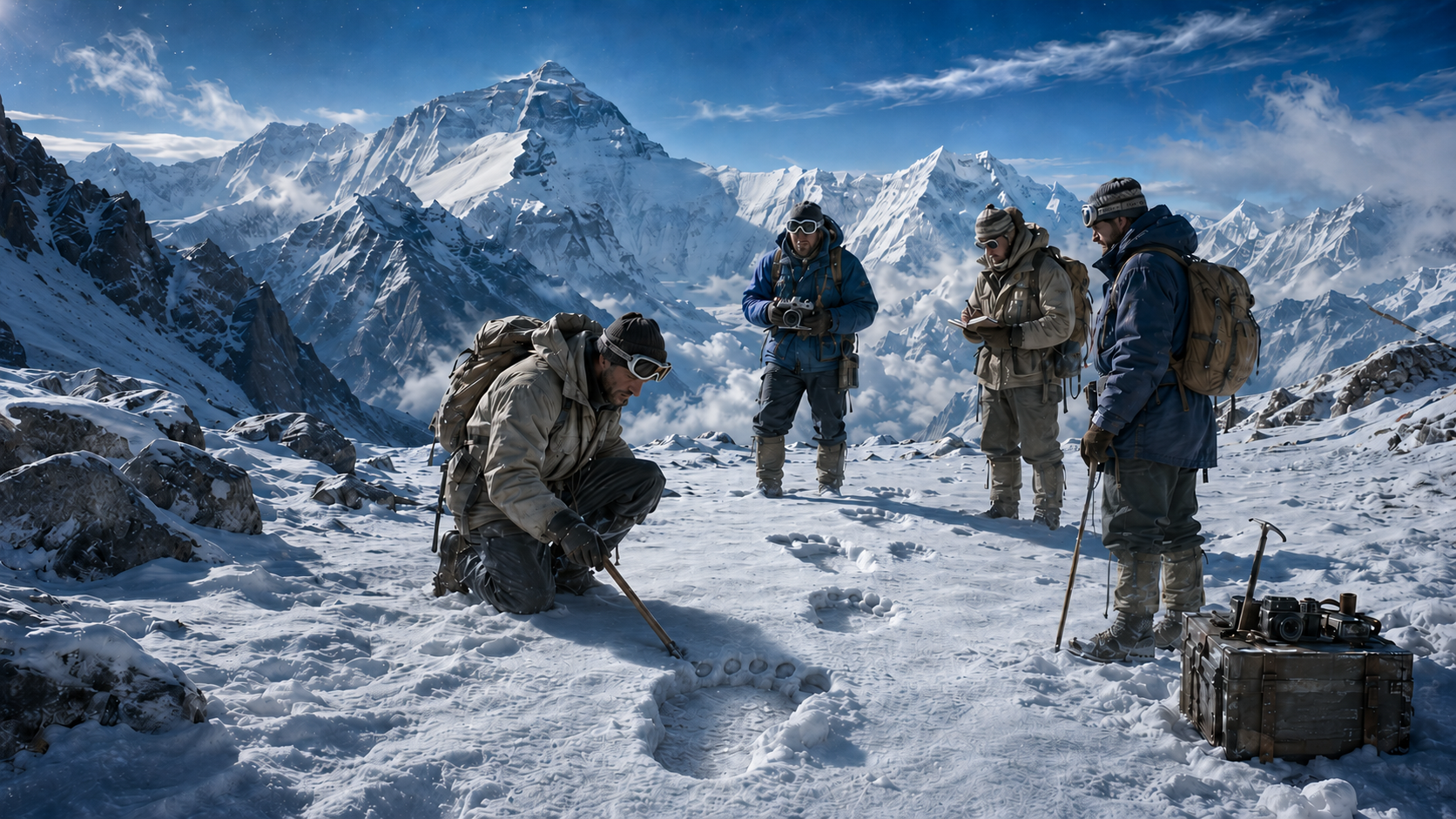
In 1960–61, Sir Edmund Hillary led a major scientific and mountaineering expedition through the Rolwaling and Khumbu regions of Nepal that included a systematic search for evidence of the Yeti. The team investigated reported footprints, local traditions and alleged Yeti relics, including the famous scalp kept at Khumjung Monastery. Their findings favored ordinary animal explanations for several traces, but the expedition became one of the most significant organized investigations in the history of the Yeti mystery.
Additional Notes
The expedition began with an intensive search in the upper Rolwaling Valley before crossing into the Khumbu region. Team members followed and photographed several sets of tracks that Sherpas initially regarded as possible Yeti traces. In a number of cases, the researchers were able to follow the tracks into shaded areas where their original shape was preserved. There they appeared more like the prints of small animals, such as foxes, suggesting that sun and wind had enlarged or distorted them into more human-like forms. The expedition also examined several alleged Yeti relics. The famous pointed “Yeti scalp” from Khumjung was temporarily loaned for scientific study and was ultimately identified as animal hide rather than the scalp of an unknown primate. A piece of supposed Yeti fur brought back during the expedition was identified as the skin of a Tibetan blue bear. Hillary’s expedition therefore concluded that the physical evidence it examined did not support the existence of an unknown snowman. One preliminary report stated bluntly that the team did not believe a Yeti had been demonstrated. Yet the expedition also showed why the mystery persisted: snow conditions could radically transform ordinary tracks, and local traditions remained deeply rooted throughout the Himalayan communities visited by the researchers. The Khumbu investigation became a landmark because it moved beyond anecdote and attempted to test specific claims in the field rather than simply collect stories.
The Location Today
The Khumbu is an active trekking region containing settlements, monasteries and high mountain routes. Sites associated with the 1960 Yeti expedition are dispersed rather than a single preserved attraction. Access depends on the chosen route and applicable park or trekking requirements.
- Environment
- Mountain
- Time of Day
- Various
- Evidence Level
- Investigated Case
- Visiting the Location
- Guided, Limited
- Ownership of the Location
- Mixed