
Summary
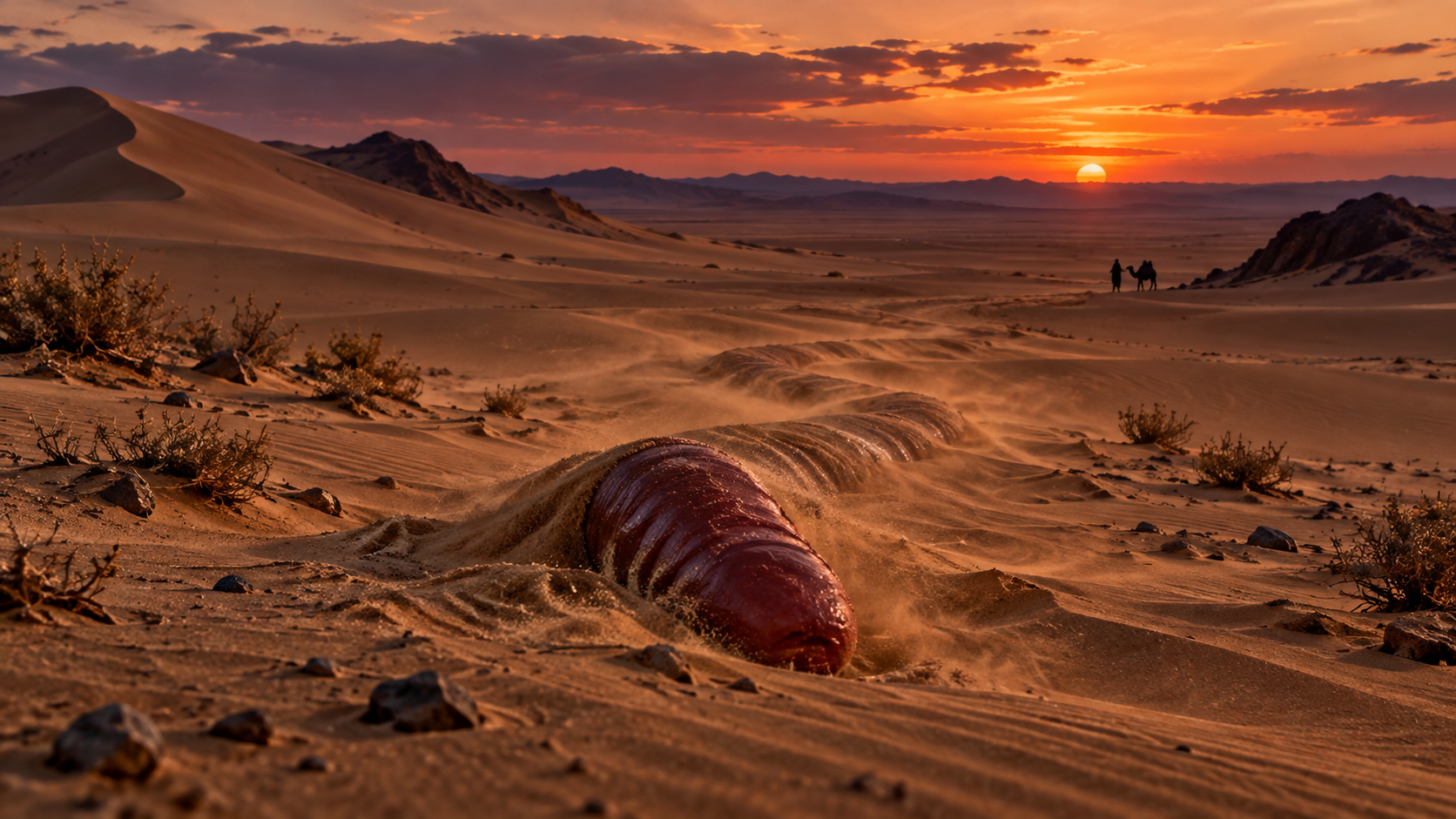
For generations, stories from Mongolia’s Gobi Desert have described a mysterious creature known as the Olgoi-Khorkhoi, or Mongolian Death Worm. It is usually portrayed as a thick, dark red, limbless animal with no obvious head, eyes or legs, living beneath the desert sand and appearing only rarely at the surface. Some accounts claim that it can kill by spraying or releasing a powerful venom, while others attribute to it a lethal electric-like discharge capable of striking from a distance. The creature entered Western literature in the 1920s through explorer Roy Chapman Andrews, and later expeditions repeatedly searched the Gobi for it without obtaining a verified specimen. Its identity remains uncertain.
Additional Notes
The Mongolian name Olgoi-Khorkhoi is generally translated as “intestine worm,” referring to the creature’s supposed resemblance to a section of animal intestine. Accounts commonly describe a thick, sausage-shaped body, usually reddish or dark red, with little visible distinction between the head and tail. Reported lengths vary, but many descriptions place it somewhere between roughly half a metre and one and a half metres. The first widely known Western record dates to 1922. During preparations for the American Museum of Natural History’s Central Asiatic Expedition, Roy Chapman Andrews met members of the Mongolian government. The Mongolian premier asked whether Andrews could capture an example of the mysterious animal if his expedition encountered one. Andrews later wrote that the officials present had not personally seen the creature, but nevertheless described it in considerable detail and appeared convinced that it existed. Andrews published the episode in his 1926 book On the Trail of Ancient Man and returned to the subject again in 1932, noting that the animal was said to inhabit particularly arid and sandy parts of the western Gobi. His expeditions themselves were primarily scientific searches for fossils and the natural history of Central Asia rather than dedicated hunts for the creature. Later accounts added details that became central to the legend. The creature was said to remain underground for much of the year, sometimes revealing its movement as a disturbance or wave in the sand, and to appear more often during the warmer summer months. Some traditions also associate it with areas where the desert plant goyo grows. Czech explorer Ivan Mackerle became one of the best-known modern investigators of the Death Worm. He organised expeditions to Mongolia in 1990, 1992 and later 2004, interviewing local people and searching areas where reports were said to occur. His teams even experimented with vibrations in the ground in an attempt to draw a buried animal to the surface. No specimen was recovered. Other searches followed during the 2000s, reflecting the persistence of the legend well into the modern era. Despite repeated expeditions, no confirmed body, skin, skeleton or unambiguous photograph has been produced. At the same time, the consistency of certain details in Gobi accounts — particularly the creature’s red coloration, thick limbless body and subterranean habits — has kept the story alive. Several natural counterparts have been suggested for the Olgoi-Khorkhoi, including snakes, legless lizards and other burrowing desert animals that might appear unfamiliar during brief encounters. Another interpretation sees the legend as part of a broader oral tradition shaped by the dangers of the Gobi, where stories of a deadly creature beneath the sand may also have served as warnings about hazardous places, venomous animals and the risks of travelling in extreme desert conditions. None of these possibilities has been shown to explain every aspect of the reports. The exact number of witnesses is impossible to determine because many accounts come from oral tradition and were collected over decades. Reports from herders, travelers and residents across the Gobi suggest that belief in the creature is widespread, extending well beyond the small number of individually documented encounters.
The Location Today
The Gobi Desert remains an immense landscape spanning remote routes, protected areas and settlements. Mongolian Death Worm traditions do not identify a single preserved sighting site.
- Environment
- Desert
- Time of Day
- Various times of the day
- Evidence Level
- Witness Report
- Visiting the Location
- Limited
- Ownership of the Location
- Unknown