
Summary
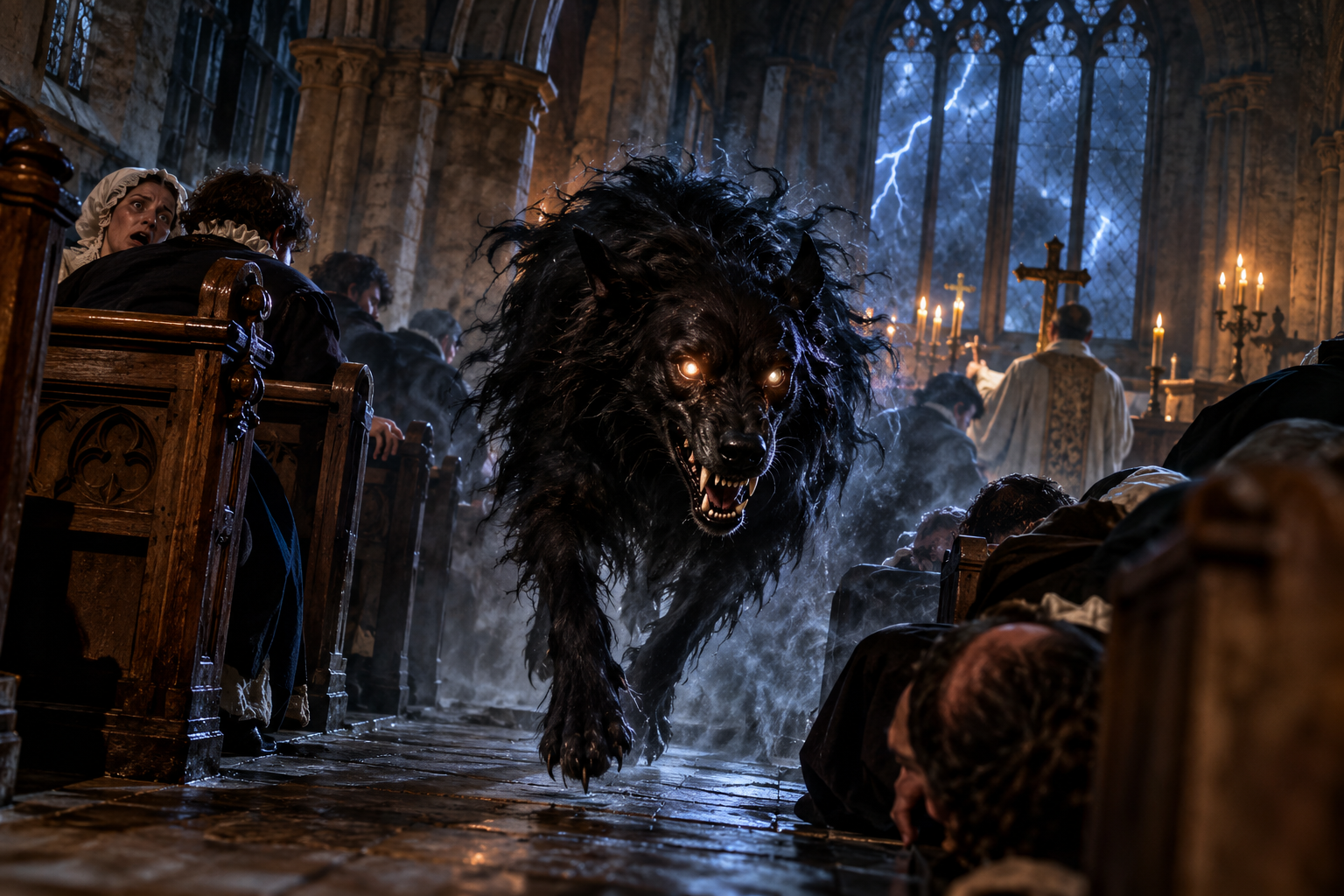
On August 4, 1577, a violent thunderstorm struck the Suffolk towns of Bungay and Blythburgh, England. According to a pamphlet published that same year by Abraham Fleming, a terrifying black, dog-like apparition appeared inside St Mary's Church in Bungay, racing through the congregation as lightning illuminated the darkness. Two worshippers reportedly died, while another man was injured. A similar apparition was described at Holy Trinity Church in Blythburgh, where further deaths and injuries were reported. Later associated with the legendary Black Shuck, the incidents became among England's most enduring supernatural accounts.
Additional Notes
On Sunday morning, August 4, 1577, a severe thunderstorm swept across Suffolk in eastern England. Inside St Mary's Church in Bungay, the congregation was attending a religious service when violent thunder, lightning, and extraordinary darkness reportedly engulfed the building. The events were described by Abraham Fleming in a pamphlet published later that year, titled *A Straunge and Terrible Wunder*. Fleming wrote that a frightening apparition resembling a black dog suddenly appeared among the worshippers. Moving with extraordinary speed through the church, the creature allegedly passed between two people kneeling in prayer, who died instantly. Another man was reportedly struck across the back and severely injured, although he survived. The pamphlet also described a second incident at Holy Trinity Church in nearby Blythburgh on the same day. There, a similarly shaped apparition was said to have appeared on a beam above the congregation before rushing through the building. Fleming reported that two men and a boy were killed, another person's hand was burned, and additional worshippers were affected. Damage to church masonry, doors, and other fittings was also mentioned. At Blythburgh, marks on a historic church door later became associated with the creature's supposed claws, although their origin has not been conclusively established. Fleming interpreted the apparition in religious terms, suggesting that it represented the Devil. However, he was not an identified eyewitness and compiled his narrative from information supplied to him. His pamphlet is therefore a contemporary written account rather than independent confirmation of the supernatural events it describes. Over subsequent centuries, the mysterious black dog became associated with Black Shuck, the spectral hound of East Anglian folklore. Often portrayed in later tradition as enormous, with glowing eyes, Black Shuck was believed to wander lonely roads, marshes, and churchyards, sometimes appearing as an omen of death. These later characteristics should not be confused with Fleming's original description, which does not specify the creature's size or eye colour. The legend has also been linked to Arthur Conan Doyle's novel *The Hound of the Baskervilles* (1902). Although Black Shuck is frequently suggested as a possible inspiration, a direct literary connection has not been conclusively established. The 1577 accounts remain a remarkable combination of historical disaster, reported apparitions, and centuries of local folklore. While the violent storm provides an important historical context, the identity and nature of the black dog described in Fleming's narrative remain matters of interpretation.
The Location Today
St Mary's Church survives as a Grade I listed historic building, together with remains of the former Benedictine priory. Holy Trinity Church in Blythburgh remains an active place of worship and a Grade I listed building. Its historic door bears marks traditionally associated with Black Shuck, although their origin is uncertain. The legend remains an important part of local folklore and heritage.
- Environment
- Urban Area, Church
- Time of Day
- Morning, approximately 9:00–10:00 AM
- Evidence Level
- Witness Report
- Visiting the Location
- Unknown
- Ownership of the Location
- Private