
Summary
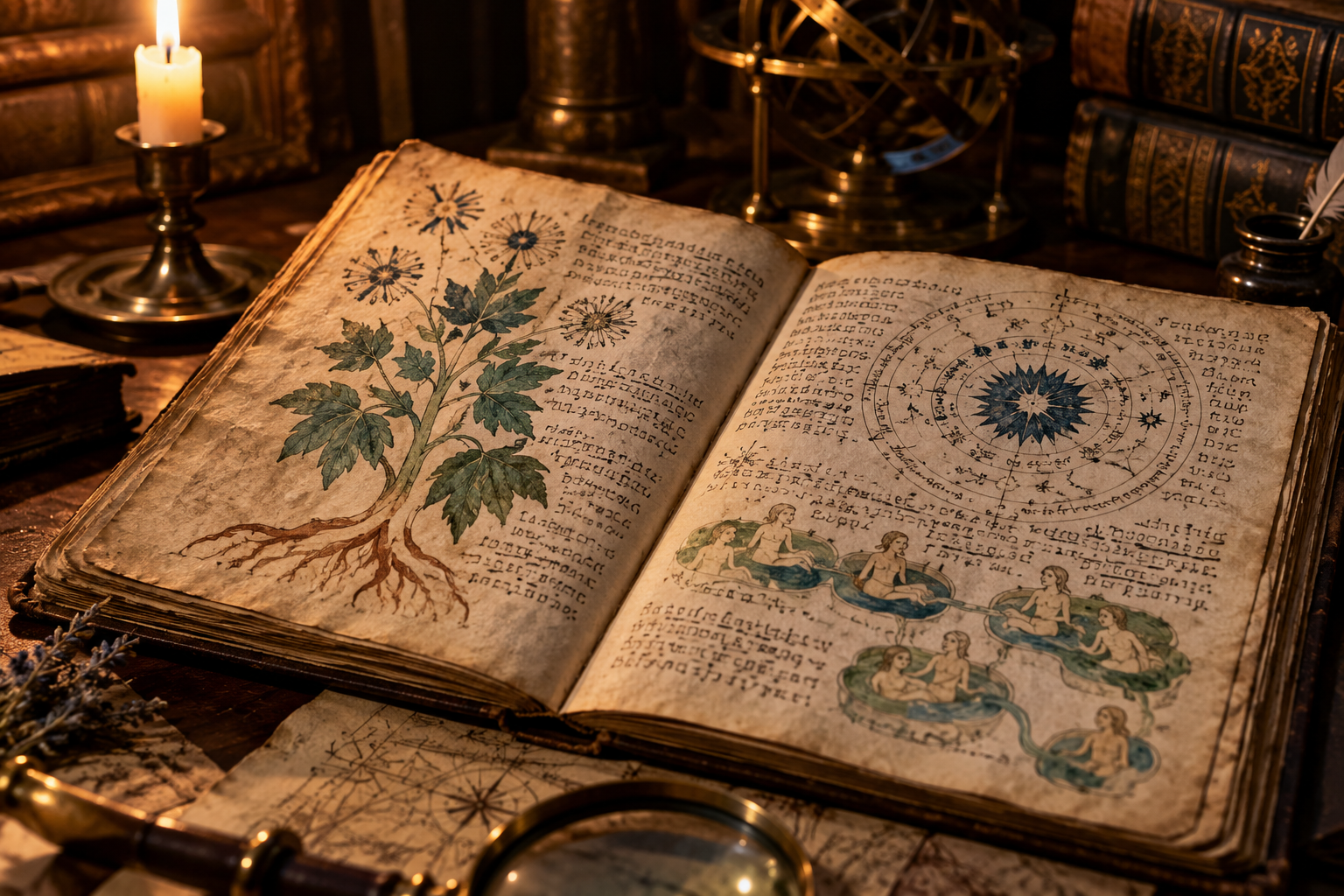
The Voynich Manuscript is an illustrated codex written in an unidentified script by an unknown author. Its parchment has been dated to the early fifteenth century, while its pages contain mysterious botanical drawings, astronomical and astrological diagrams, bathing figures, pharmaceutical imagery and extensive undeciphered text. Numerous linguists, cryptographers and historians have attempted to determine whether the writing represents a natural language, cipher or another constructed system, but no interpretation has gained general acceptance. Today preserved at Yale University as Beinecke MS 408 (Beinecke Rare Book & Manuscript Library, Yale University), the manuscript remains one of the world's most enduring historical enigmas.
Additional Notes
The manuscript consists of approximately 240 surviving vellum pages, some of them arranged as elaborate foldouts. Its illustrations suggest several broad sections: unidentified or imaginary-looking plants, astronomical and astrological diagrams, groups of small human figures associated with baths and interconnected vessels, cosmological designs, pharmaceutical drawings of roots and herbs, and pages of shorter text entries marked by star-like symbols. The accompanying writing uses a distinctive and still unidentified script. The manuscript's early history is incomplete. Yale identifies Holy Roman Emperor Rudolf II as its first confirmed owner and records a later chain of ownership involving Jacobus Horčicky de Tepenec, Georgius Barschius and Johannes Marcus Marci. In 1666, Marci sent the manuscript to Jesuit scholar Athanasius Kircher together with a letter that remains with the volume. An old attribution to the medieval scholar Roger Bacon is now regarded as speculation. The manuscript disappeared from the documented record for centuries before antiquarian bookseller Wilfrid M. Voynich acquired it from the Jesuit College at Frascati near Rome in 1912. After passing through several later owners, bookseller H. P. Kraus donated it to Yale's Beinecke Library in 1969. Scientific examination of its materials has supported its historical age, but attempts to understand the text have produced competing linguistic, cryptographic and artificial-language theories without an accepted decipherment. The central mystery therefore remains unusually intact: the physical manuscript is real, preserved and extensively studied, yet its author, purpose and written content remain unknown.
The Location Today
Beinecke Rare Book & Manuscript Library, Yale University, New Haven, Connecticut. The library is free and open to the public, but access to the original Voynich Manuscript is restricted and normally limited to exceptional scholarly research.
- Environment
- Library
- Time of Day
- Unknown time of day
- Evidence Level
- Investigated Case
- Visiting the Location
- Free Access, Limited
- Ownership of the Location
- Private