
Summary
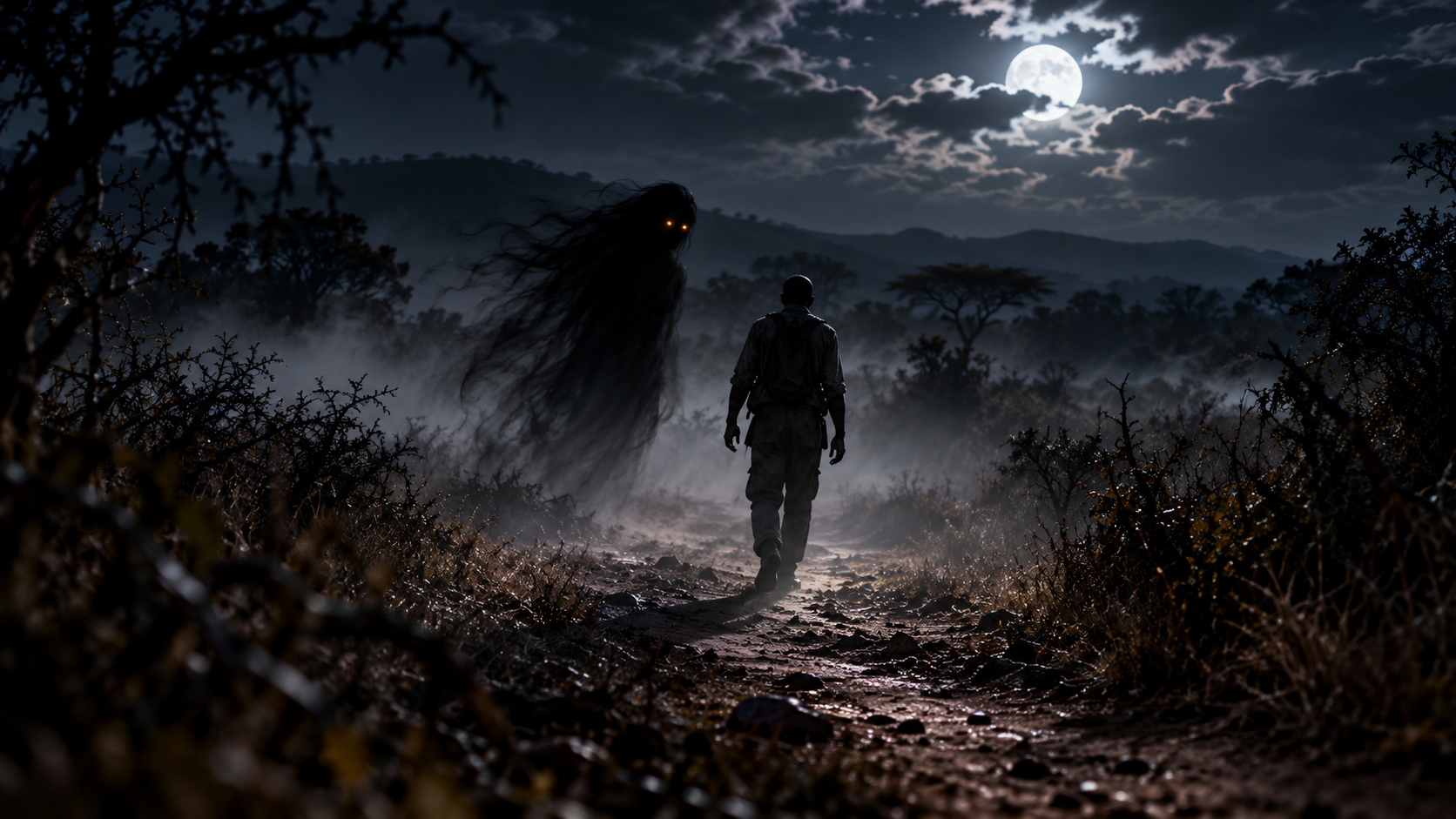
In the South African Lowveld, local traditions describe the sauwe as an elusive supernatural presence believed to seize a person's mind and lead them away from their intended path. Richard Malatsi reported two disturbing experiences, in 1988 and 1997. During the first, he awoke in an unexpected place at his parents' home. During the second, he reportedly wandered through dense bushland after leaving a tavern, eventually reaching the fence of a nature reserve. Malatsi believed the sauwe released him only at sunrise. His account was documented by anthropologist Isak Niehaus in a scientific article published in 2023.
Additional Notes
In the villages of South Africa's Lowveld, the sauwe is traditionally described as a mysterious presence capable of taking control of a person's sense of direction. Unlike a conventional ghost, it rarely appears as a recognisable human figure. Local accounts sometimes describe it as a dark shadow or black cloud, while others portray it as entirely invisible. According to these traditions, the sauwe particularly affects people walking alone late at night. Victims may believe they are travelling home, only to discover that they have wandered towards graveyards, unfamiliar buildings, or isolated bushland. Richard Malatsi, who frequented a tavern called GaMokoena, reported two experiences that he attributed to this phenomenon. In 1988, Malatsi awoke on the floor of his parents' ancestral hut. He had apparently hung his clothing over a clay pot, seemingly unaware of his unusual surroundings. The circumstances leading to his arrival there were not clearly established. Nine years later, in 1997, he experienced a more disturbing episode. After leaving GaMokoena, Malatsi reportedly walked past a secondary school and a graveyard before entering dense bushland. He eventually reached the fence of a nature reserve and continued alongside it, searching for an opening. When he regained his bearings, Malatsi believed that he had been walking throughout the night and that the sauwe's influence had ended at sunrise. Other residents told similar stories of people unexpectedly wandering towards cemeteries or awakening in places they had not intended to visit. One research assistant described encountering a neighbour walking in the wrong direction while insisting that he was heading home. These accounts were documented by anthropologist Isak Niehaus in a peer-reviewed study published in 2023. His research examined both the reported experiences and their place within local beliefs about restless spirits, death, and displacement. The sauwe remains a distinctive example of South African ghost folklore associated not with a single haunted building, but with mysterious journeys through a familiar landscape. The reported experiences have not been independently verified as supernatural events.
The Location Today
Impalahoek in Mpumalanga is not a designated paranormal tourist attraction. The sauwe traditions are associated with the wider village landscape rather than a single publicly identifiable site. Visitors should respect local communities, private property, and restricted nature-reserve boundaries.
- Environment
- Village / Rural Area, Bushland
- Time of Day
- Night / Early morning
- Evidence Level
- Witness Report
- Visiting the Location
- Unknown
- Ownership of the Location
- Mixed