
Summary
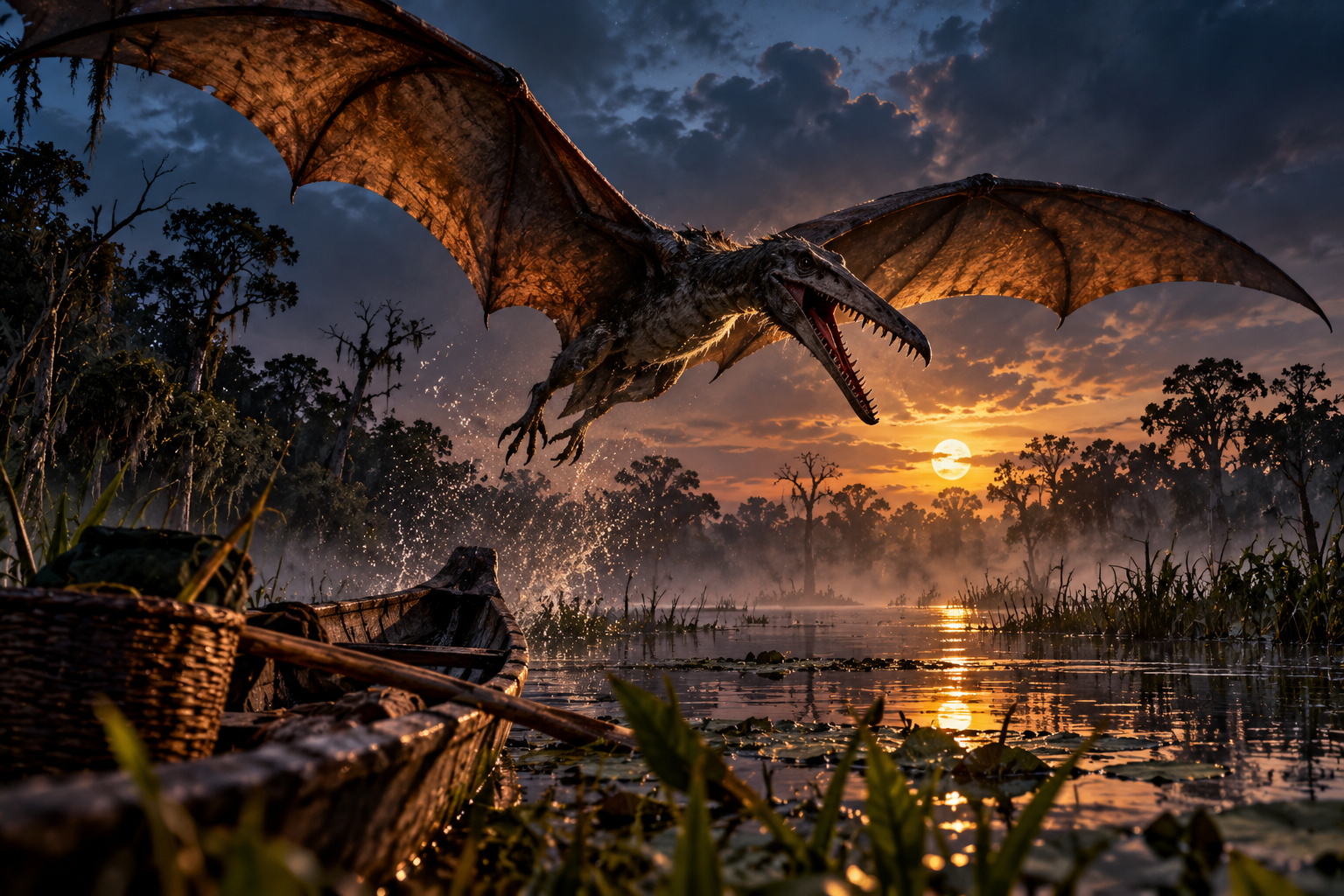
In the swampy riverlands of northwestern Zambia, local Kaonde traditions describe the Kongamato, a feared winged creature associated with dangerous waterways and overturned canoes. British administrator Frank H. Melland recorded these accounts in his 1923 book In Witch-Bound Africa. According to his informants, the creature resembled a bird or reptile with leathery wings, a toothed beak, and no feathers. Melland's comparison with prehistoric flying reptiles later helped establish the Kongamato as a famous African cryptid. However, the historical record consists primarily of reported beliefs and secondhand accounts. No verified specimen, photograph, or independently confirmed sighting establishes the creature's existence.
Additional Notes
The Kongamato entered the international literature of mysterious creatures through Frank H. Melland's 1923 book In Witch-Bound Africa, which documented the beliefs and traditions of the Kaonde people in what was then Northern Rhodesia. Melland associated the creature particularly with the Jiundu Swamp and dangerous river crossings in the Kasempa region. Local accounts described an elusive, winged being feared by travellers using canoes or attempting to cross waterways. The name was interpreted approximately as a creature capable of overwhelming boats. Descriptions collected by Melland portrayed the Kongamato as having leathery, bat-like wings, a largely featherless body, and a beak containing teeth. Reported wingspans varied, with some descriptions suggesting approximately four to seven feet. The creature was not merely an unusual animal in these traditions. It was also associated with sudden flooding, dangerous currents, and the mysterious overturning of boats. Protective charms were reportedly used before crossing certain rivers, reflecting the Kongamato's place in local beliefs about hazardous waterways. Melland noted similarities between the descriptions and illustrations of prehistoric flying reptiles. This comparison became especially influential in later cryptozoological writing, where the Kongamato was sometimes presented as a possible surviving pterosaur. Further references appeared in twentieth-century literature, including Charles R. S. Pitman's A Game-Warden Takes Stock in 1942. Such accounts demonstrate the persistence of the tradition but do not independently establish the existence of an unknown animal. The historical reports remain difficult to evaluate. Much of the evidence is secondhand, exact observation dates are uncertain, and no authenticated physical remains or diagnostic photographs are known. The Kongamato therefore occupies an intriguing position between regional folklore and cryptozoology: a documented tradition associated with a real landscape, but without verified zoological evidence.
The Location Today
The Kongamato tradition is associated with the Jiundu Swamp region and surrounding waterways of northwestern Zambia, historically within the wider Kasempa area. These landscapes include remote wetlands, river crossings, and wooded terrain. The precise places mentioned in early accounts cannot be confidently identified using modern maps, and no authenticated Kongamato observation site or dedicated visitor attraction has been established. Travelling into remote wetland areas may require local guidance and permission.
- Environment
- Forest, River, Swamp / Marsh
- Time of Day
- Unknown time of day
- Evidence Level
- Folklore
- Visiting the Location
- Unknown
- Ownership of the Location
- Unknown