
Summary
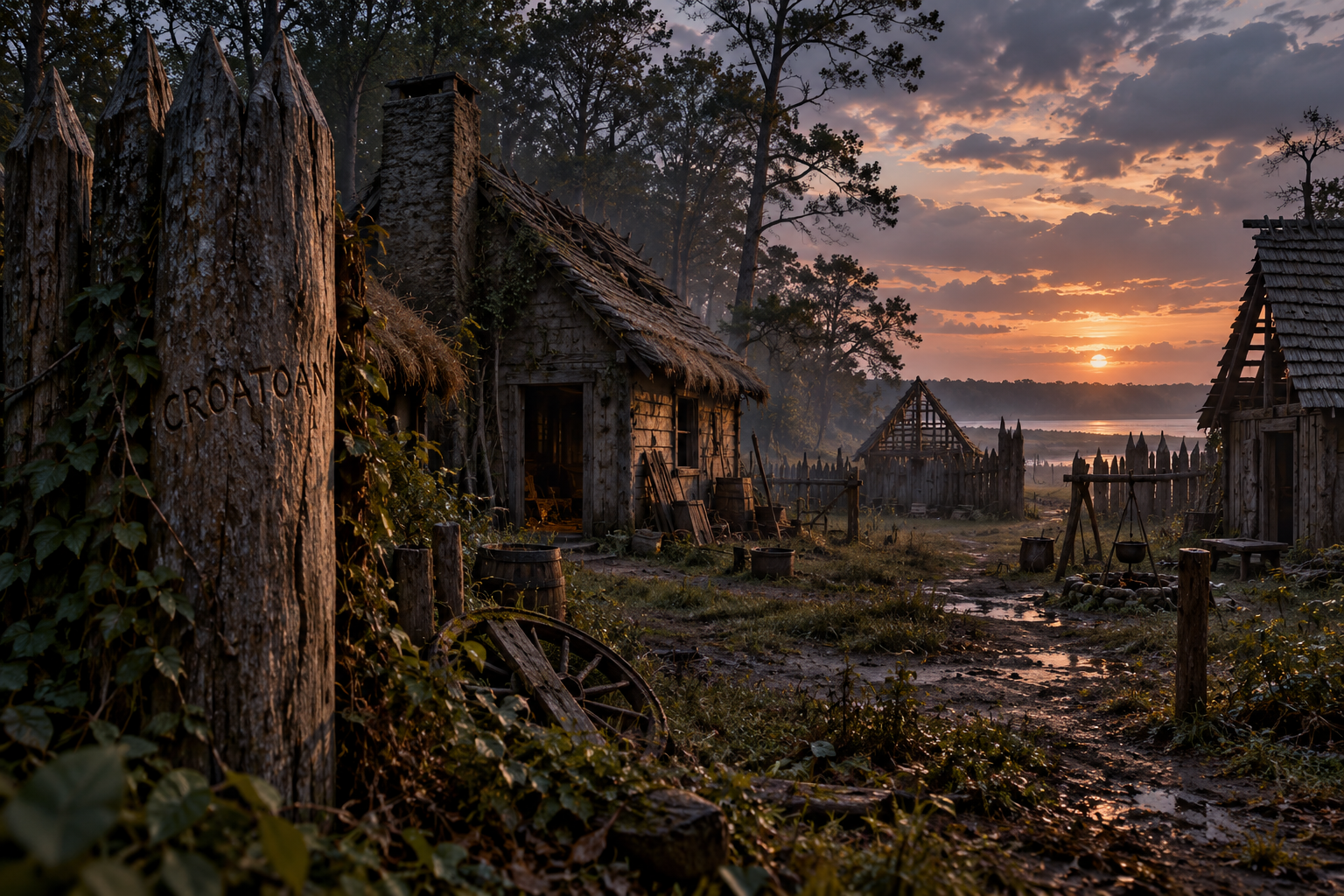
In 1587, an English colony of 117 men, women and children was established on Roanoke Island in present-day North Carolina. Governor John White sailed to England for supplies but was unable to return until 1590. He found the settlement abandoned, with no colonists or bodies present and the words “CRO” and “CROATOAN” carved at the site. The message suggested that the settlers had relocated, possibly to Croatoan, now Hatteras Island. Historical and archaeological evidence supports several possible destinations, but the ultimate fate of the colony remains uncertain.
Additional Notes
The 1587 colonists originally intended to establish a settlement in the Chesapeake Bay, but their expedition stopped at Roanoke Island, where they repaired buildings left by an earlier English colony. Food shortages and deteriorating relations with local Algonquian communities soon created serious difficulties. The settlers asked Governor John White to return to England for supplies, leaving behind 117 colonists, including his daughter Eleanor Dare and his newborn granddaughter Virginia Dare. Before White departed, the colonists agreed that if they moved they would leave a message identifying their destination. They also planned to divide, with some remaining temporarily on Roanoke while others moved inland. War between England and Spain delayed White's return until August 1590. When he finally reached the settlement, the houses had been removed and no colonists or bodies were found. “CRO” had been carved into a tree and “CROATOAN” into a palisade post. No sign indicating that the settlers had departed under duress was reported. Croatoan was not a mysterious code but the name of both an Indigenous community and their island, now Hatteras Island. White interpreted the inscription as indicating that the colonists had gone there and attempted to investigate, but severe weather prevented the expedition from reaching the island. He never saw the colonists again. Relocation and integration with Indigenous communities therefore remain among the strongest explanations. Archaeological finds on Hatteras Island and inland have added intriguing evidence of English activity, but none has conclusively identified the fate of all the colonists. The National Park Service notes that no graves, settlement remains or other evidence has yet definitively linked the Lost Colony to Hatteras. The mystery today is therefore less whether the settlers simply “vanished” than where the different groups went and what ultimately became of them.
The Location Today
Fort Raleigh National Historic Site, Roanoke Island, North Carolina. The historic area associated with the Roanoke colonies is preserved by the National Park Service, although the precise layout and full extent of the 1587 settlement remain uncertain.
- Environment
- Coast / Beach, Island, Colonial Settlement
- Time of Day
- Unkown time of day
- Evidence Level
- Investigated Case
- Visiting the Location
- Free Access
- Ownership of the Location
- Public