
Summary
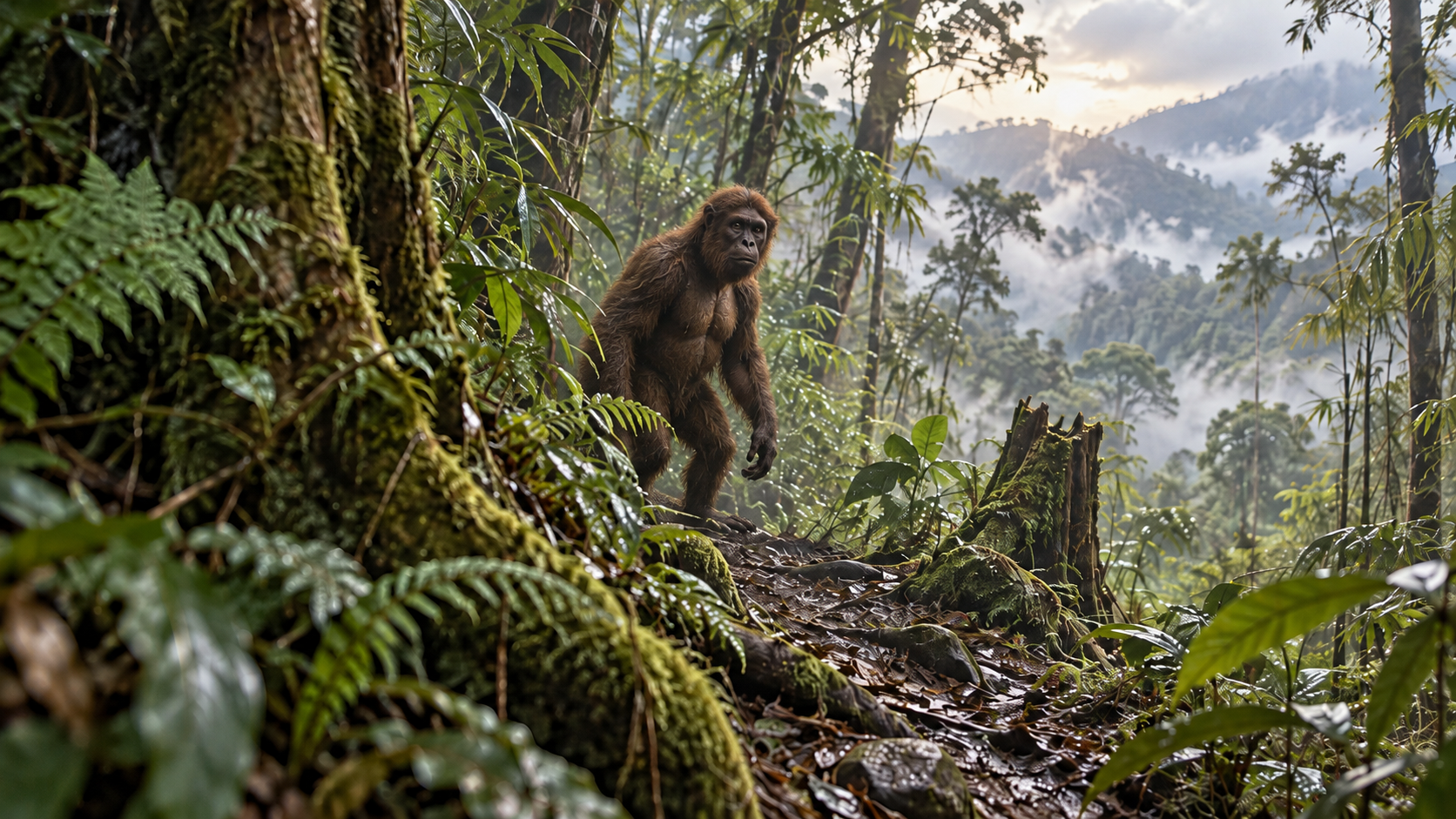
Kerinci Seblat National Park in central Sumatra is the best-known modern hotspot for reports of the Orang Pendek, a small, powerfully built, upright creature described as distinctly non-human but primate-like. Witnesses commonly report a height of roughly one to one and a half metres, broad shoulders, relatively short legs, long arms and brown, reddish or dark hair. Reports from the Kerinci region extend back into the colonial period and continued through intensive investigations during the late twentieth century. Despite numerous eyewitness accounts and alleged footprints, no specimen, photograph or verified biological evidence has confirmed the existence of an unknown primate.
Additional Notes
Written reports of mysterious upright primates from southern and central Sumatra date back at least to the early twentieth century. In 1915, unusual human-like footprints were reported near Danau Bento southeast of Mount Kerinci, while several sightings were recorded during the 1910s and 1920s. A Dutch plantation worker living in Kerinci reported a close encounter in 1927 with a small, hairy creature that fled while leaving human-like tracks. Modern interest increased sharply after British journalist and conservationist Deborah Martyr began investigating Orang Pendek reports in the Kerinci region in the late 1980s. She collected extensive eyewitness testimony from villagers, hunters and forest workers and later reported seeing the animal herself on several occasions. Her descriptions emphasized a small but strongly built bipedal primate rather than a miniature human or supernatural figure. One of the most notable modern encounters occurred in October 1994, when wildlife photographer Jeremy Holden reported seeing an unfamiliar bipedal animal inside Kerinci Seblat National Park from a distance of only about seven metres. Holden described it as approximately 1.5 metres tall, muscular, covered in yellowish-brown hair and moving upright on two legs. Although he was carrying a camera, he did not photograph the animal. Following these reports, Holden joined a three-year search supported by Fauna & Flora International beginning in 1995. The Indonesian Ministry of Forestry library preserves records of Project Orang Pendek field reports from this period, demonstrating that the search developed into a sustained wildlife investigation rather than a series of isolated cryptozoological expeditions. Gunung Tujuh and the forests surrounding the Lake of Seven Peaks became particularly important search areas. Later expeditions reported finding unusual bipedal tracks there, and local residents continued to describe sightings of small, upright, dark-haired animals. A 2021 report collected during a later expedition involved a witness who described a roughly one-metre-tall reddish-brown humanoid creature running into the forest and subsequently found tracks that he associated with the animal. The identity of the reported creature remains unresolved. Suggested explanations include misidentified gibbons or other known primates, sun bears seen briefly in unusual postures, folklore, hoaxes or an unknown terrestrial primate. Anthropological research is particularly interesting because local Sumatran classifications often treat Orang Pendek as a real type of animal rather than necessarily as a supernatural spirit. The name itself means approximately “short person.” 1994 is used here as the sort year because Holden’s close-range sighting marks one of the best documented modern encounters and directly preceded the organized Fauna & Flora International research program. The Orang Pendek tradition itself is substantially older.
The Location Today
Kerinci Seblat National Park remains a large protected mountain and rainforest landscape on Sumatra. Reports of Orang Pendek concern forest areas rather than a marked or independently established encounter site. Some designated routes can be visited under park rules.
- Environment
- Forest, Mountain
- Time of Day
- Various times of the day
- Evidence Level
- Investigated Case
- Visiting the Location
- Ticketed, Limited
- Ownership of the Location
- Unknown