Summary
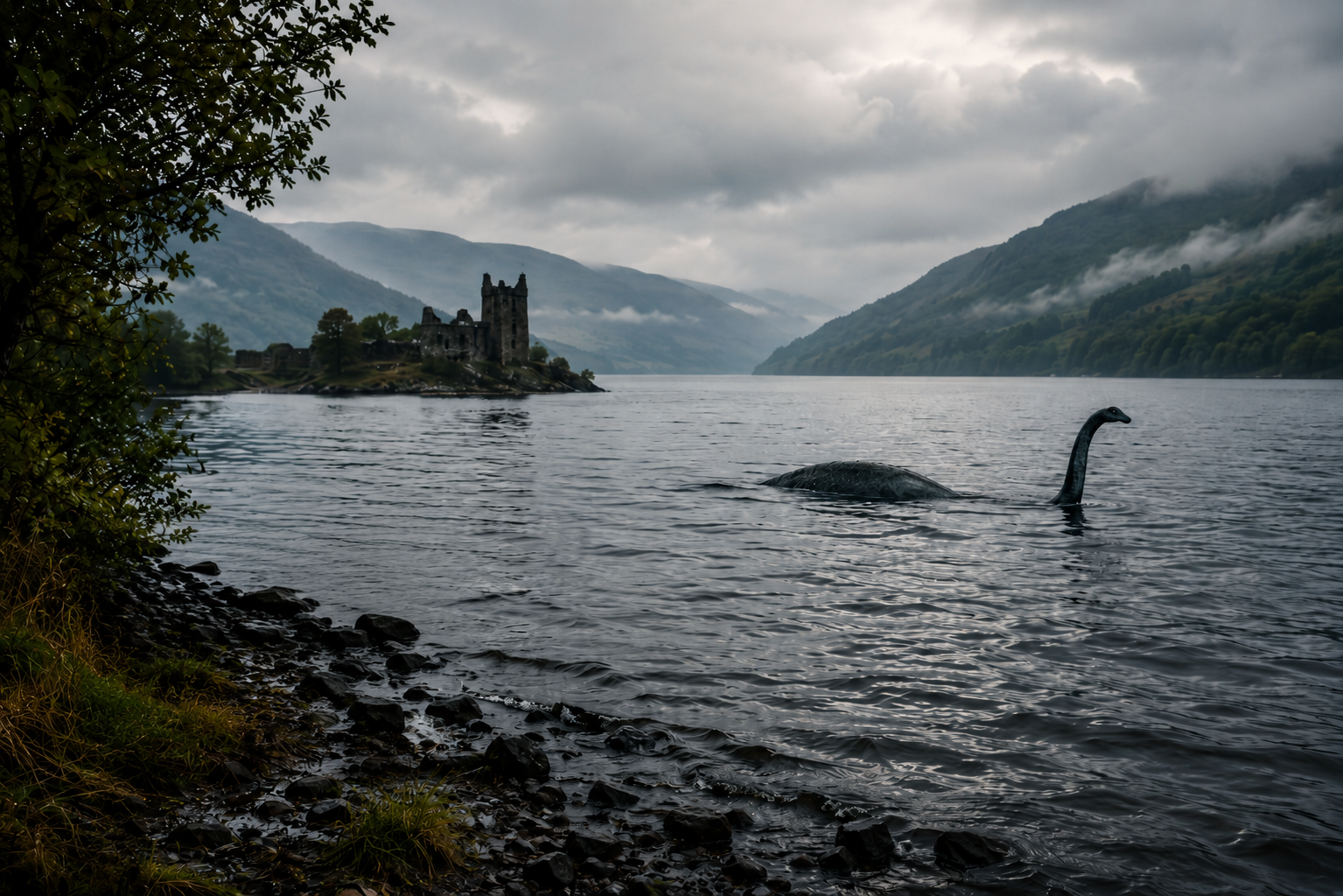
Loch Ness has been the center of one of the world’s most famous cryptid mysteries since a series of sightings in 1933 transformed older local traditions into the modern legend of “Nessie.” Witnesses have reported large bodies, humps and long-necked forms moving through the dark waters, while photographs, films and sonar contacts have fueled decades of investigation. Some famous evidence has been exposed as hoaxed or misidentified, yet occasional unexplained observations continue to keep the mystery alive.
Additional Notes
Around AD 565, St. Columba was later said to have confronted a “water beast” in the River Ness. The story was recorded by Adomnán roughly a century later and is often cited as an early precursor to the Loch Ness Monster legend, although it does not describe the modern “Nessie” phenomenon itself. The modern Nessie phenomenon began in 1933, when Aldie and John Mackay reported seeing a large disturbance and an unusual animal-like form in Loch Ness. Later that year, Hugh Gray produced the first widely publicized photograph claimed to show the creature. Numerous further sightings followed, alongside films and photographs of varying quality. Not all famous evidence survived scrutiny. The iconic 1934 “Surgeon’s Photograph,” showing an apparent long neck rising from the water, was eventually revealed as a deliberate hoax. Other sightings have been attributed to boats, wakes, floating debris, seals or unusual wave effects. In 1987, Operation Deepscan used a fleet of sonar-equipped boats to sweep the loch. Three deep-water contacts could not be relocated or immediately identified, although investigators did not consider them evidence of a giant monster. The contacts remain unexplained but may have involved debris, thermal effects, seals or other ordinary causes. A major environmental-DNA survey later examined about 250 water samples. Researchers found no evidence supporting a plesiosaur or other unknown giant reptile, but detected abundant eel DNA. Project leader Neil Gemmell therefore noted that unusually large eels remain one possible explanation for at least some Nessie reports, although the study could not determine the size of individual eels. Reports span many decades, so the witness count given here represents a conservative estimate rather than a documented total.
The Location Today
Loch Ness remains a major Scottish freshwater loch with public viewpoints, visitor facilities and commercial boat cruises. These options do not imply unrestricted access to the entire shoreline, and sightings were reported at many different locations.
- Environment
- Lake
- Time of Day
- Various
- Evidence Level
- Investigated Case
- Visiting the Location
- Free Access, Ticketed, Guided, Limited
- Ownership of the Location
- Mixed