
Summary
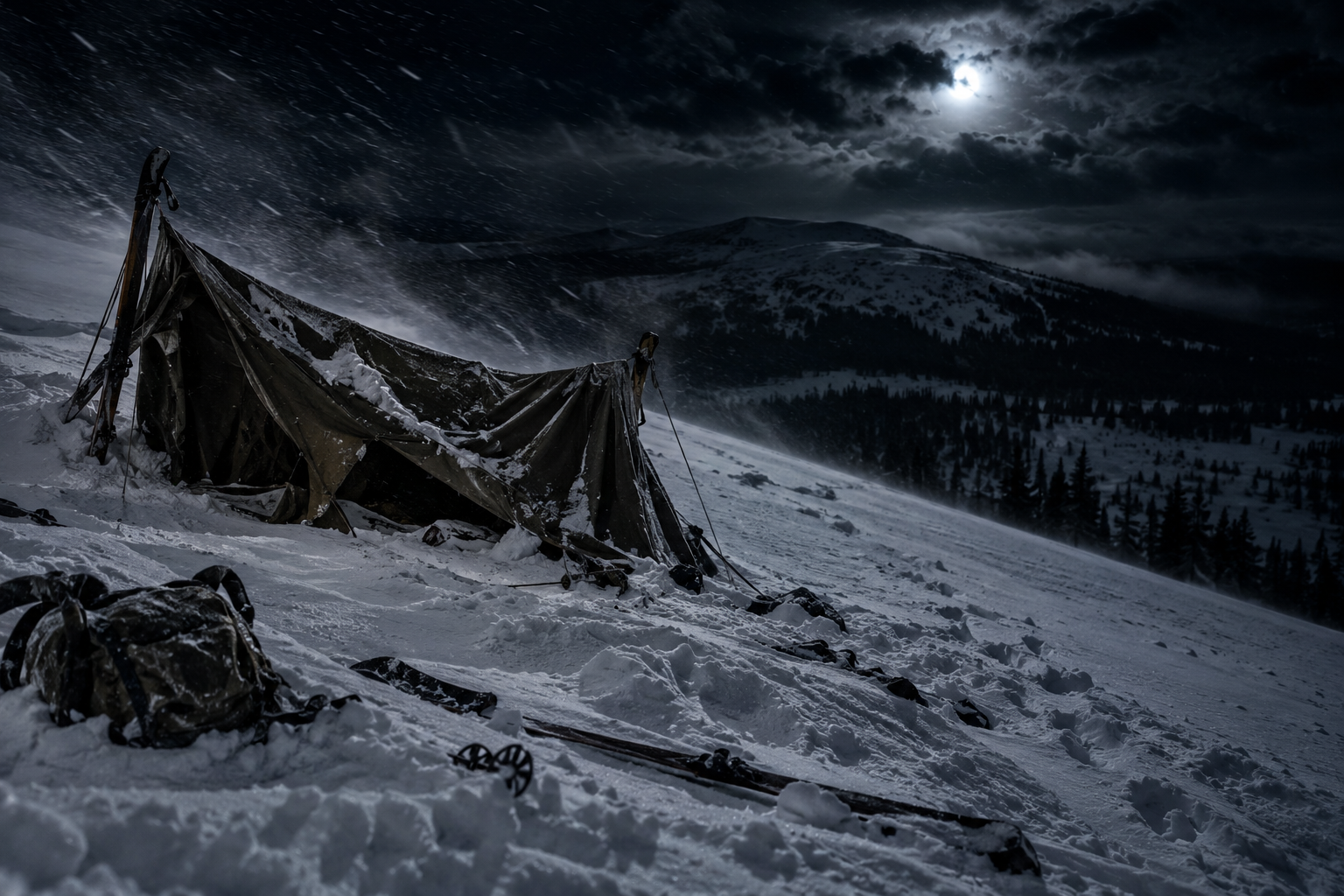
In February 1959, nine experienced hikers led by Igor Dyatlov died under extraordinary circumstances during a winter expedition in the northern Ural Mountains. Their tent was found abandoned on the slope of Kholat Syakhl, with clothing and equipment left behind and cuts made from inside the tent. The bodies were discovered at different locations between the campsite and a forest more than a kilometer downslope. A snow-slab avalanche is now considered a scientifically plausible trigger, but it does not provide a complete reconstruction of everything that occurred that night
Additional Notes
On February 1, 1959, Igor Dyatlov and eight other experienced hikers established their final campsite on the eastern slope of Kholat Syakhl in the northern Ural Mountains. During the night, an unknown emergency caused the group to abandon the tent rapidly despite extreme cold and inadequate clothing. When searchers located the campsite on February 26, footwear, outer clothing, food, equipment and personal belongings remained inside. Forensic examination concluded that significant cuts in the tent fabric had been made from the inside. The first bodies were discovered near a cedar tree at the edge of the forest and between the forest and the abandoned tent. Four additional members were found only in May beneath deep snow in a ravine. While hypothermia accounted for several deaths, some victims had severe chest or skull injuries. Other frequently cited details — including missing soft tissue and elevated radioactive contamination detected on some clothing — contributed to decades of speculation involving military activity, weapons testing and other extraordinary explanations. A renewed Russian investigation concluded in 2020 that an avalanche was responsible for the disaster. In 2021, researchers Johan Gaume and Alexander Puzrin presented a more specific physical model involving a relatively small snow-slab avalanche. They proposed that the cut made into the slope when establishing the campsite, combined with continued wind-driven snow accumulation above the tent and a weak underlying snow layer, could have produced a delayed slab release. Their simulations also demonstrated that such a slab could plausibly have caused severe but initially non-fatal injuries consistent with some of the autopsy findings. Follow-up expeditions strengthened important parts of this hypothesis. High-resolution terrain surveys identified slopes above possible tent locations exceeding the angles required for avalanche release, while actual slab avalanches were documented in the Dyatlov Pass region. Researchers also observed how wind-blown snow could rapidly obscure traces of a small avalanche, providing a possible explanation for why searchers saw no obvious avalanche evidence weeks after the incident. The snow-slab hypothesis nevertheless does not reconstruct every event of the night. It provides a scientifically supported mechanism for an emergency at the campsite and potentially for some of the injuries, but the exact sequence of decisions after the group left the tent, the circumstances surrounding individual injuries and other disputed details cannot be established with certainty. Reports of unusual lights in the wider region also became part of the later mystery, although documented sightings on other dates cannot be assumed to have been connected to the hikers' deaths. The Dyatlov Pass incident therefore has a strong natural explanation for important elements of the tragedy while its complete chronology remains uncertain.
The Location Today
Dyatlov Pass is a remote mountain pass in the northern Ural Mountains associated with the deaths of nine hikers in 1959. It remains a wilderness destination rather than a developed memorial attraction, and reaching it requires substantial expedition planning.
- Environment
- Mountain
- Time of Day
- Night
- Evidence Level
- Official Record
- Visiting the Location
- Limited
- Ownership of the Location
- Unknown