
Summary
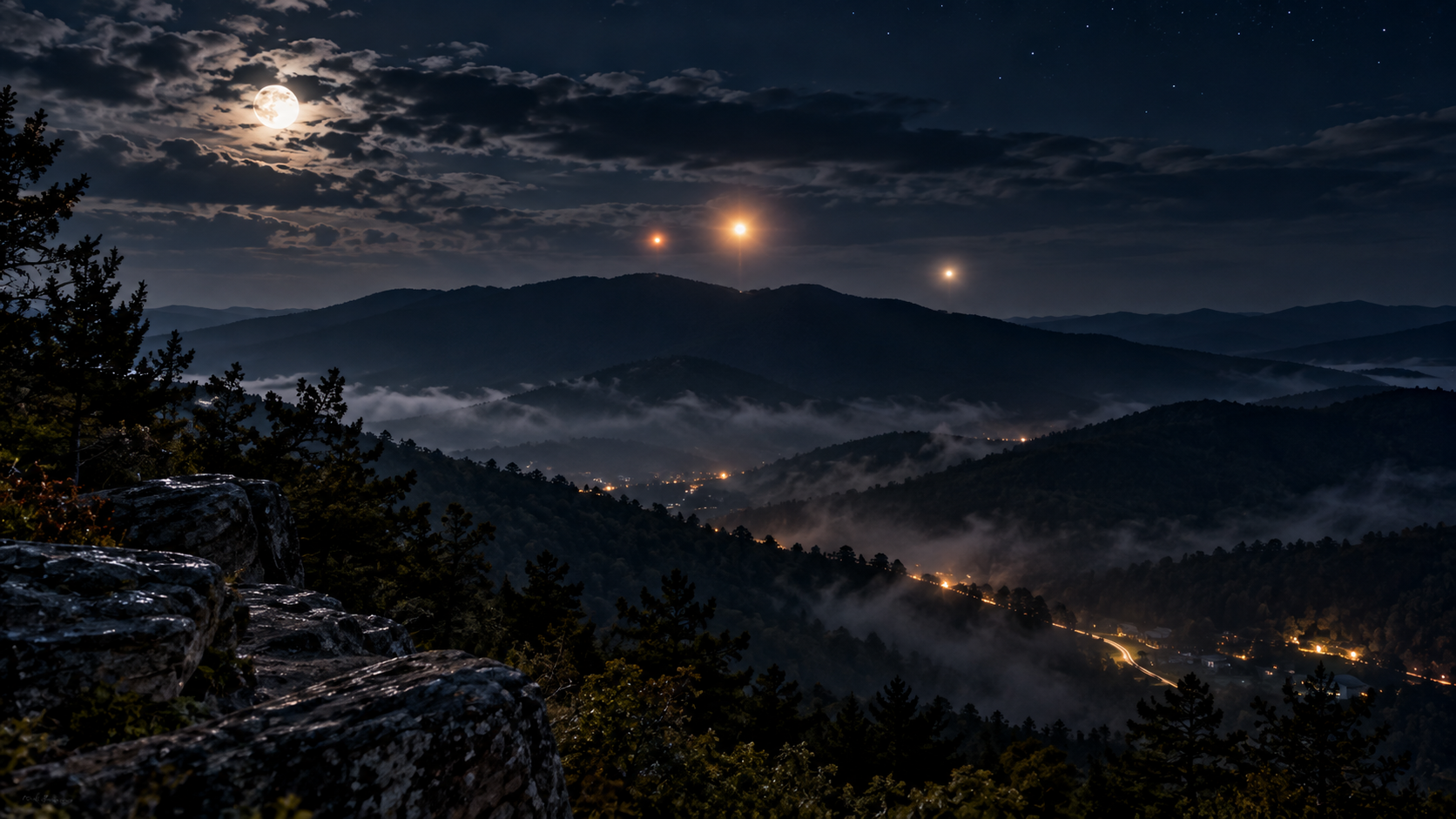
For more than a century, mysterious lights have been reported around Brown Mountain in western North Carolina, appearing as bright points or glowing lights that emerge, move or disappear against the mountain landscape. The phenomenon became widely known after newspaper reports in 1913 and was subsequently investigated by the U.S. Geological Survey. Government investigators identified automobile and locomotive headlights, stationary lights and fires as the sources of the lights they studied. Reports nevertheless continued, turning the Brown Mountain Lights into one of North Carolina's best-known unexplained-light legends.
Additional Notes
The Brown Mountain Lights became widely known in 1913, when newspaper reports described mysterious lights appearing near Brown Mountain in western North Carolina. Local accounts later claimed that similar lights had been noticed earlier, but 1913 provides a firm documentary starting point for the modern public history of the phenomenon. The U.S. Geological Survey first investigated the reports in 1913. A more extensive investigation was conducted in 1922 by geologist George Rogers Mansfield, who observed the region from several locations and compared the apparent positions and timing of the lights with known sources in the surrounding valleys. Mansfield instrumentally studied 23 lights during seven nights of observation. He attributed approximately 47 percent to automobile headlights, 33 percent to locomotive headlights, 10 percent to stationary lights and 10 percent to brush fires. Atmospheric conditions in the mountain valleys could alter the apparent brightness and visibility of distant lights, helping them appear suddenly or disappear from view. Mansfield concluded that the lights he investigated were not unusual in origin. The investigation did not, however, constitute an examination of every Brown Mountain Lights report ever made. Sightings and local stories continued after the USGS investigations, and the phenomenon became firmly embedded in regional folklore. Today, the National Park Service itself mentions the legend at the Lost Cove Cliffs Overlook on the Blue Ridge Parkway, while noting that studies indicate normal sources such as vehicle headlights probably account for the reports. The Brown Mountain Lights therefore occupy an unusual position between documented optical observations and folklore. Many sightings have convincing conventional explanations, while individual historical or modern reports may lack enough information for a specific identification. The continued mystery rests less on evidence for a single unknown phenomenon than on more than a century of reports made from the mountains surrounding Brown Mountain.
The Location Today
Brown Mountain remains a forested ridge in western North Carolina. The phenomenon can be sought from several surrounding viewpoints; Lost Cove Cliffs Overlook at Milepost 310 of the Blue Ridge Parkway is an official public viewpoint where the National Park Service specifically mentions the Brown Mountain Lights legend. (https://www.nps.gov/places/lost-cove-cliffs-overlook.htm)
- Environment
- Forest, Mountain, Valley
- Time of Day
- Night
- Evidence Level
- Official Record
- Visiting the Location
- Free Access
- Ownership of the Location
- Public