
Summary
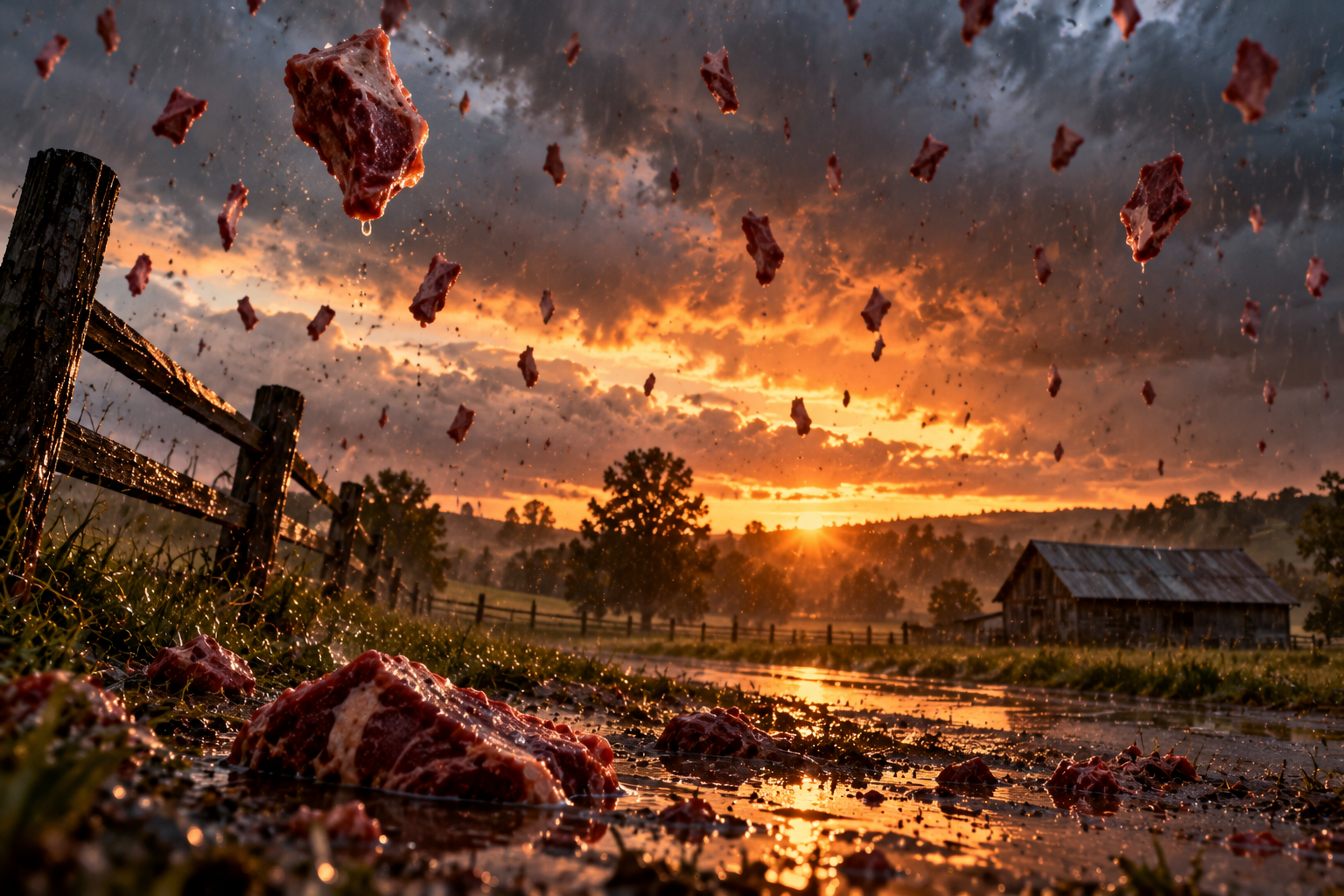
On March 3, 1876, something extraordinary fell from a clear sky over a farm in rural Bath County, Kentucky: pieces of fresh, flesh-like material scattered across the ground. Witnesses described the substance as meat, and samples sent to scientists were later identified as various forms of animal tissue. The event generated nationwide attention and explanations ranging from unusual biological material to a flock of vultures disgorging a recent meal. The vulture theory remains the leading explanation — but no one witnessed the birds responsible, and the precise circumstances of the bizarre shower were never established.
Additional Notes
On the afternoon of March 3, 1876, Rebecca Crouch was outside at the family farm near Olympia Springs in Bath County when pieces of flesh-like material began falling from an apparently clear sky. Contemporary reports described an area roughly 100 by 50 yards as being scattered with pieces, many around two inches across, although larger fragments were also reported. The incident lasted only several minutes and quickly attracted local and national attention. The material was not simply assumed to be meat. Samples were examined microscopically by several nineteenth-century investigators, producing surprisingly varied results. Arthur Mead Edwards argued that the substance was genuine animal flesh, while other examinations reportedly identified structures resembling lung tissue, muscular tissue and cartilage. An alternative suggestion that the material was Nostoc — a gelatinous cyanobacterium that swells when wet — therefore became increasingly difficult to reconcile with the microscopic findings. The explanation that eventually attracted the most support was almost as strange as the mystery itself: vultures. Physician Lewis D. Kastenbine proposed that a flock feeding on carrion could have simultaneously regurgitated its meal while flying overhead. Vultures are capable of rapidly disgorging stomach contents when threatened or disturbed, and such an event could explain both the genuine animal tissues and their sudden distribution across a relatively small area. However, no flock was documented above the Crouch farm during the shower, leaving the theory plausible rather than demonstrated. Remarkably, the story did not end in 1876. A specimen associated with the Kentucky Meat Shower survives in the collection of Transylvania University in Lexington. Modern attempts to learn more from historical material have not established the animal species responsible, leaving one of America's strangest nineteenth-century incidents with a probable mechanism — but no definitive reconstruction of what happened above the Crouch farm that afternoon.
The Location Today
The 1876 event occurred on the Crouch family's rural property south of Olympia Springs in Bath County, Kentucky. The historical site is not a developed public attraction, although the surrounding rural landscape remains closely associated with the story. A preserved specimen attributed to the Meat Shower is held by Transylvania University in Lexington.
- Environment
- Field / Farmland, Village / Rural Area
- Time of Day
- Afternoon, approximately 2:00 p.m.
- Evidence Level
- Investigated Case
- Visiting the Location
- Limited, No Public Access
- Ownership of the Location
- Private