
Summary
On August 15, 1977, the Ohio State University’s Big Ear radio telescope detected an exceptionally strong, narrowband radio signal during a SETI sky survey. Lasting approximately 72 seconds and appearing near the 1420 MHz hydrogen line, its intensity rose and fell in a pattern consistent with a fixed celestial source passing through the telescope’s beam. Astronomer Jerry Ehman later discovered the unusual sequence “6EQUJ5” in the recorded data and wrote “Wow!” beside it. Despite numerous follow-up searches, the signal has never been conclusively detected again and its origin remains unresolved.
Additional Notes
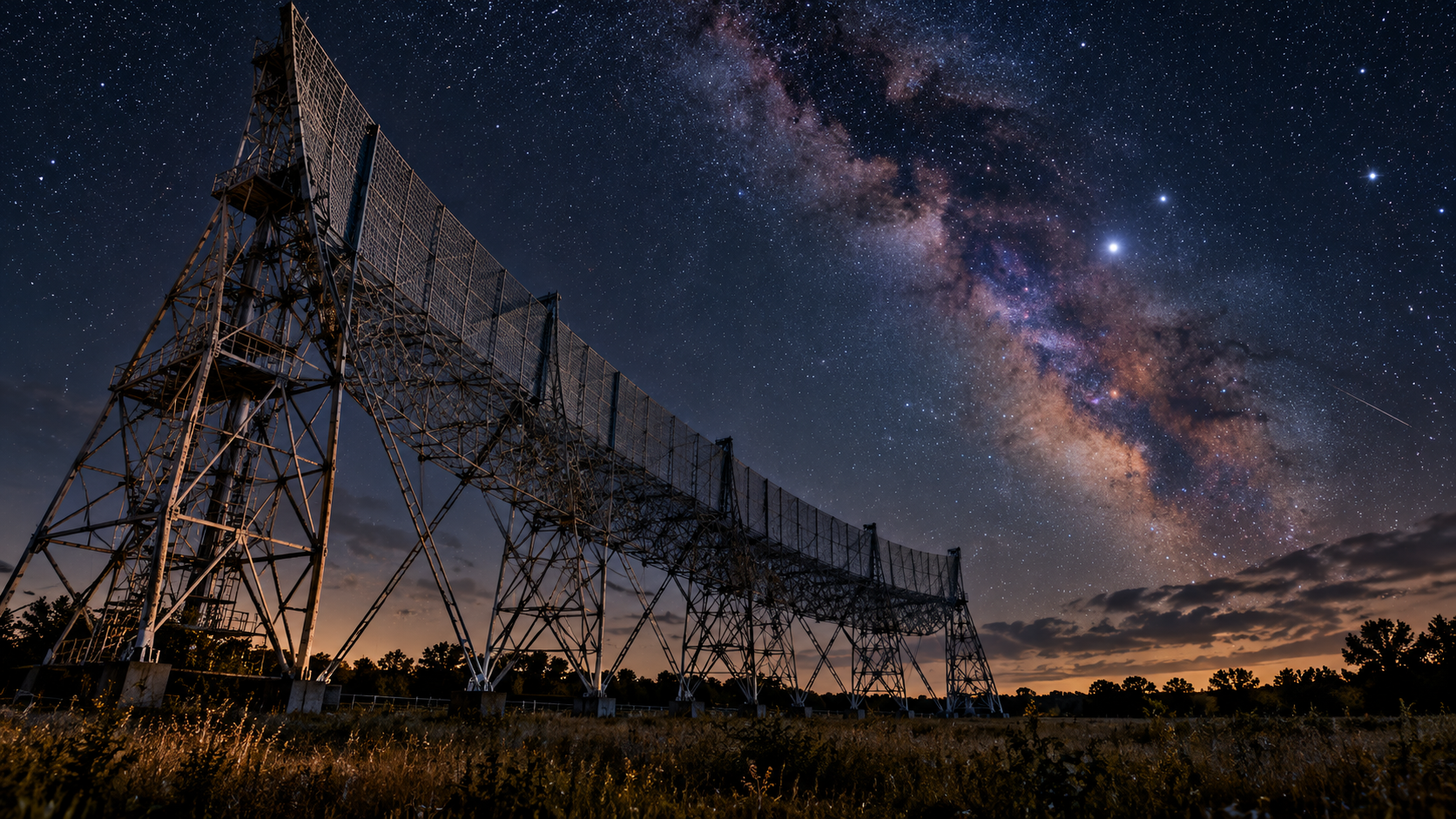
The Wow! Signal was recorded during a routine sky survey conducted by the Ohio State University Radio Observatory, commonly known as Big Ear. The telescope was searching for narrowband radio emissions that might distinguish artificial signals from ordinary cosmic radio noise. The detected signal appeared close to the 1420 MHz frequency associated with neutral hydrogen and persisted for approximately 72 seconds, corresponding closely to the time a fixed point in the sky would take to pass through Big Ear’s observing beam as Earth rotated. The signal was not heard or interpreted as a message. Instead, the telescope’s computer represented measured signal intensity using numbers and letters. The resulting sequence, “6EQUJ5,” showed the signal rapidly increasing in strength and then declining. When volunteer astronomer Jerry Ehman examined the printout, he circled the sequence and wrote “Wow!” in red ink, unintentionally giving the event its lasting name. The signal attracted particular attention because its rise and fall resembled the response expected from a distant fixed source rather than an obvious local radio transmission. However, it appeared only once and was not detected again when the same region of sky was subsequently observed. Numerous later searches, including observations with other radio telescopes, have also failed to establish a recurring source. No evidence has demonstrated that the signal was produced by extraterrestrial technology. More recent research has revived the possibility of a natural astrophysical origin. Studies using archival Arecibo and Big Ear observations identified weaker narrowband emissions associated with compact clouds of cold neutral hydrogen and proposed that a transient energetic event could temporarily amplify such emission through maser-like or superradiance processes. A 2025 reanalysis also refined the possible sky positions of the Wow! Signal and estimated a peak flux exceeding 250 Jy at approximately 1420.726 MHz. These findings provide new avenues for explaining the event but have not identified its source conclusively, leaving the Wow! Signal unresolved.
The Location Today
The Big Ear radio telescope no longer exists. The observatory was decommissioned in 1998; the historic site is remembered through displays and a nearby historical marker in the Delaware, Ohio area.
- Environment
- Observatory
- Time of Day
- Night
- Evidence Level
- Investigated Case
- Visiting the Location
- Limited
- Ownership of the Location
- Unknown