
Summary
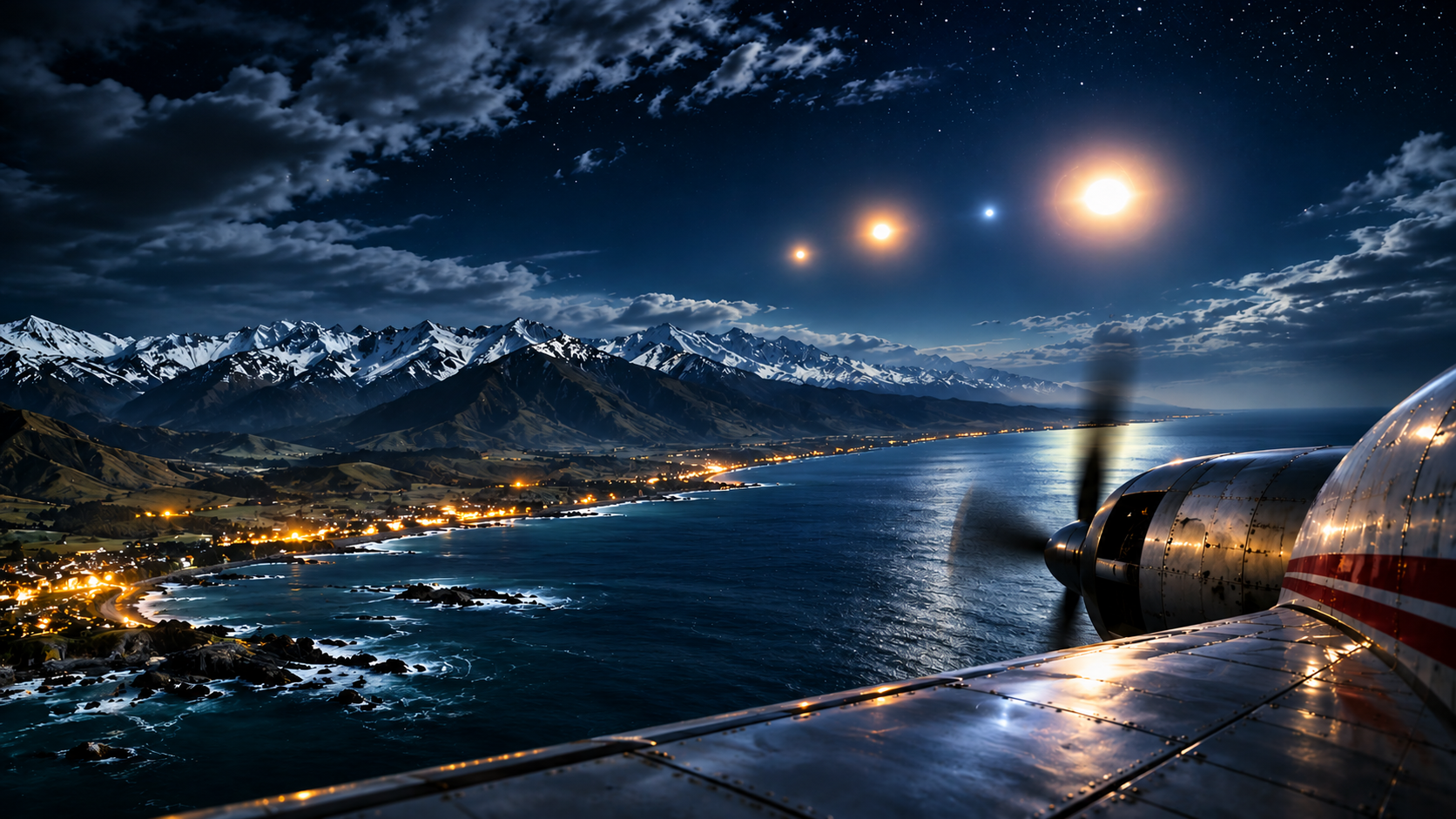
In December 1978, mysterious lights appeared over the sea near Kaikōura, New Zealand, reportedly accompanying cargo aircraft flying along the South Island's eastern coast. Pilots described brilliant objects behaving strangely, while air traffic controllers recorded unusual radar returns. When a television crew joined a follow-up flight on December 30–31, the lights appeared again — and were captured on colour film. The footage attracted international attention and prompted an official investigation by the Royal New Zealand Air Force. Investigators proposed explanations involving planets, fishing vessels, atmospheric conditions and radar effects, but not every reported observation was conclusively resolved. The Kaikōura Lights remain one of New Zealand's best-documented UFO controversies.
Additional Notes
During the final days of 1978, a series of extraordinary aerial sightings drew international attention to the waters off Kaikōura, on New Zealand's South Island. What began as reports from cargo pilots soon developed into one of the country's most extensively investigated UFO incidents. On the night of December 20–21, crews aboard Safe Air Argosy aircraft reported unusual lights while flying along the eastern coast. Some appeared to change position unexpectedly or move in relation to the aircraft. Air traffic controllers in Wellington also detected unidentified radar returns, raising questions about whether the pilots were observing something more than distant lights. The reports attracted considerable media interest. On December 30, an Australian television team joined another Safe Air flight to investigate. Reporter Quentin Fogarty, cameraman David Crockett and sound recordist Ngaire Crockett accompanied pilots Bill Startup and Bob Guard on the journey from Wellington to Christchurch. During the flight, bright lights were observed again. On the return journey in the early hours of December 31, witnesses watched a particularly prominent light that appeared to remain near the aircraft. Crockett captured unusual luminous images on 16 mm colour film. The footage was subsequently broadcast internationally, transforming the sightings into a major UFO controversy. The apparent combination of eyewitness testimony, radar observations and film made the case especially intriguing. However, the records do not demonstrate that every radar return and filmed light represented the same physical object. New Zealand's Royal New Zealand Air Force investigated the incidents, with scientific input from the Department of Scientific and Industrial Research. Investigators examined possible explanations including Venus and Jupiter, lights from fishing vessels, atmospheric refraction, reflections and anomalous radar propagation. The official inquiry concluded that most observations could be explained through combinations of these factors, although some details remained inconclusive. Critics, including optical physicist Bruce Maccabee, challenged aspects of the photographic analysis and argued that certain observations had not been adequately explained. The original footage and government investigation records survive, allowing the case to be examined beyond eyewitness recollections alone. New Zealand's audiovisual archives also preserve contemporary interviews and documentary material. Nearly half a century later, the Kaikōura Lights remain a striking example of how difficult it can be to interpret unusual observations made at night from a moving aircraft. The existence of the reports, radar detections and filmed lights is documented; whether all their causes have been satisfactorily identified remains a matter of debate. At least five people are documented as participants in the television crew's flight, while additional witnesses, including pilots and air traffic controllers, reported unusual observations during the December 1978 incidents, bringing the total number of potential witnesses higher, although the exact figure remains unknown.
The Location Today
The Kaikōura coastline remains a publicly accessible coastal region on New Zealand's South Island. The reported lights were observed from aircraft flying over the sea, so no single ground location marks the sightings.
- Environment
- Coast / Beach, Airborne
- Time of Day
- Night / Early Morning
- Evidence Level
- Official Record
- Visiting the Location
- Free Access
- Ownership of the Location
- Mixed