
Summary
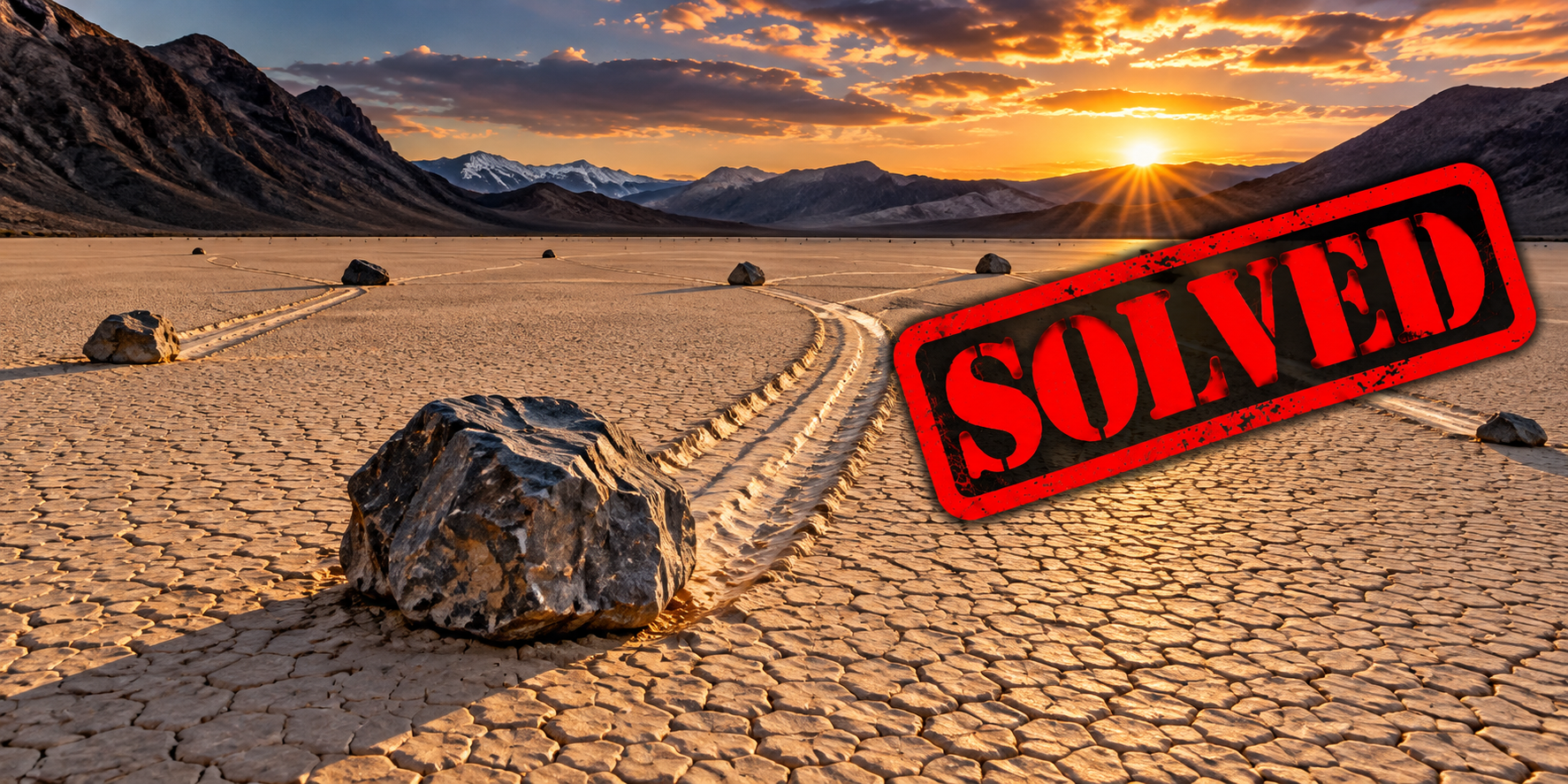
For decades, rocks at Racetrack Playa in California's Death Valley appeared to move mysteriously across the dry lakebed, leaving long trails behind them despite no one seeing them move. Some stones weigh hundreds of kilograms, and their tracks can extend for hundreds of meters. In 2013 and 2014, researchers finally observed and recorded the movement directly. They found that a rare combination of shallow water, thin floating ice and light winds can slowly push rocks across the softened playa surface. The long-standing mystery of the Sailing Stones is therefore considered solved.
Additional Notes
Racetrack Playa is a remarkably flat dry lakebed in a remote part of Death Valley National Park. For decades, visitors and researchers found rocks scattered across its surface with long grooves extending behind them. Some trails ran nearly straight, while others curved, changed direction or appeared alongside remarkably similar tracks from neighboring stones. Because the rocks could remain stationary for years and movement had never been directly observed, numerous explanations were proposed, including strong winds, dust devils, water and ice. To investigate the phenomenon, researchers installed a weather station, time-lapse cameras and specially prepared rocks containing motion-activated GPS units. In December 2013, they encountered the rare conditions required for movement: rain and snow had created a shallow pond on the playa, which froze during cold nights. During sunny mornings, the ice began to melt and broke into large, thin floating sheets. Light winds of approximately 3–5 meters per second pushed these floating ice panels across the shallow water. Although only a few millimeters thick, the ice exerted enough force to push rocks slowly across the muddy lakebed. Researchers directly observed more than 60 rocks moving during one event, while GPS-equipped stones recorded movements extending up to 224 meters over multiple events. The rocks generally travelled only a few meters per minute, making their movement difficult to notice from a distance. The discovery showed that neither hurricane-force winds nor thick ice capable of lifting the rocks were necessary. Instead, an unusual combination of water, freezing temperatures, sunshine, thin floating ice and gentle wind produces the famous tracks. Because these conditions occur only rarely, individual stones can remain motionless for many years, explaining why generations of visitors saw the trails but almost never witnessed the rocks moving. The central mystery of the Sailing Stones is therefore considered solved.
The Location Today
The sailing stones are located at Racetrack Playa in Death Valley National Park, California. The remote dry lakebed can be reached by a rough backcountry road that generally requires a high-clearance four-wheel-drive vehicle; off-road driving is prohibited.
- Environment
- Desert, Dry Lakebed
- Time of Day
- Various times of day
- Evidence Level
- Investigated Case
- Visiting the Location
- Limited
- Ownership of the Location
- Public